

You’ve been served with a summons and complaint in a Virginia civil lawsuit. After responding, you may receive written questions, requests for documents, and notices that require you to provide information about the dispute. Or perhaps you’re considering filing a lawsuit and have heard that the case could spend months in something called “discovery.” Why can this stage take so long, and what happens during all that time?
The discovery process is where each side formally gathers information and evidence about a civil dispute before trial. What can look like inactivity from the outside may involve attorneys reviewing documents, questioning witnesses, obtaining third-party records, addressing objections, and following up on new information.
Discovery can also change how the parties view a case. An email that appears damaging on its own may have a different meaning when the entire conversation is produced. A witness who seemed certain about what happened may give different testimony under oath. Financial records may support or contradict a claim for damages.
Whether you’re considering bringing a lawsuit, have recently been sued, or are trying to determine what comes next in a Virginia civil dispute, knowing what discovery involves can help you make more informed decisions about litigation.

At a Glance
- Discovery is the formal process parties use to obtain information and evidence before trial.
- Virginia discovery methods include interrogatories, requests for documents, requests for admission, and depositions.
- Parties can seek relevant, nonprivileged information within the scope permitted by Virginia’s discovery rules.
- Emails, texts, photographs, business files, and other electronic information may be discoverable.
- Discovery can take months when a case involves extensive records, numerous witnesses, third parties, experts, or disputes over what must be disclosed.
- Failing to comply with discovery obligations can lead to court intervention and, in some circumstances, sanctions.
- What the parties learn during discovery can affect settlement discussions, mediation, and preparation for trial.
What Is the Discovery Process in a Virginia Civil Lawsuit?
The discovery process is the pretrial procedure through which parties obtain information relevant to a lawsuit. In Virginia circuit courts, discovery is governed primarily by Part Four of the Rules of the Supreme Court of Virginia.
Virginia Rule 4:1 identifies discovery methods that include depositions upon oral examination or written questions, interrogatories, requests for production of documents and electronically-stored information, physical and mental examinations, and requests for admission.
Discovery serves a practical purpose. A civil trial isn’t supposed to be the first time one side learns about the evidence supporting the other side’s claims or defenses.
Consider a homeowner who is thinking about suing a contractor after discovering extensive defects in a renovation. The homeowner may have photographs, repair estimates, invoices, text messages, and an inspection report. The contractor may have subcontractor records, change orders, emails, photographs, and witnesses who dispute the homeowner’s account.
If litigation begins, discovery gives both sides a formal way to obtain relevant information before trial. It also illustrates why even a dispute that initially appears straightforward can require considerable time and work once civil litigation begins.
What Information Can the Other Side Obtain During Discovery?
Virginia Rule 4:1 permits discovery concerning nonprivileged information relevant to the subject matter of the pending action. Information doesn’t necessarily have to be admissible at trial to fall within the permitted scope of discovery.
Depending on the civil matters involved, discoverable information could include:
- Contracts and amendments
- Emails and text messages
- Financial and accounting records
- Photographs and videos
- Invoices and receipts
- Property and business records
- Communications between the parties
- Information about potential witnesses
- Electronic files and other electronically stored information
- Relevant records held by third parties
That doesn’t mean the other party is entitled to every document or piece of personal information you possess. Privilege and other protections can apply. Rule 4:1 also permits courts to limit discovery that is unreasonably cumulative or duplicative, obtainable from a more convenient or less burdensome source, or unduly burdensome or expensive under the circumstances.
For example, if one party demands years of unrelated personal financial information in a dispute involving a single real estate transaction, a lawyer can evaluate whether an objection or request for court protection is appropriate.
If you’ve received discovery requests, don’t decide on your own what to disclose, delete, or withhold. A civil litigation attorney can review the requests and help determine how to respond.

What Are the Main Types of Discovery in Virginia?
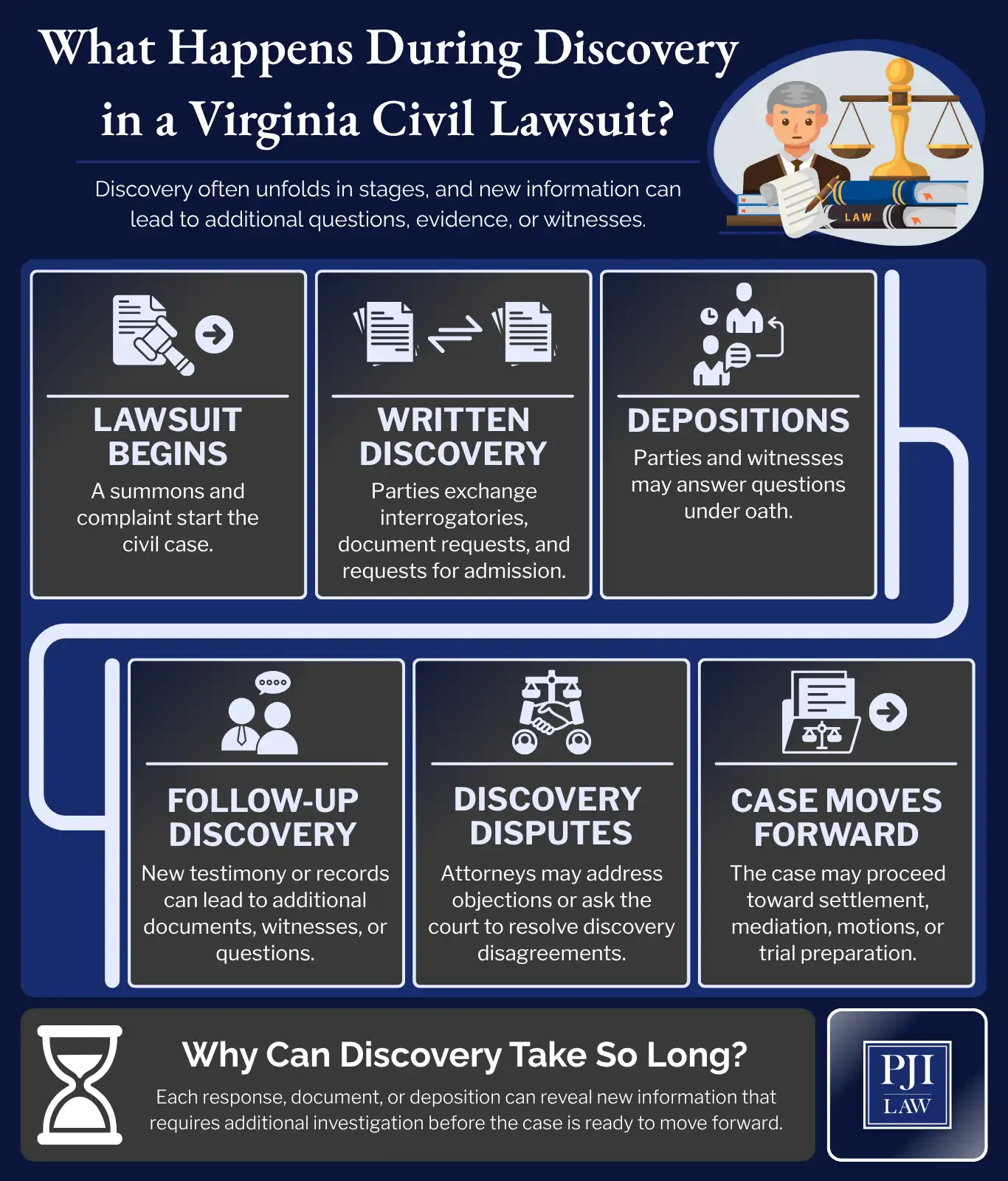
Different discovery methods serve different purposes. Some require written answers, others seek documents or electronic information, and depositions allow attorneys to question witnesses and parties under oath.
Interrogatories
Interrogatories are written questions one party serves on another party. The responding person must answer separately and fully in writing under oath unless an objection applies.
Under Virginia Rule 4:8(g), a party may not serve more than 30 interrogatories, including parts and subparts, on another party without leave of court for good cause.
Interrogatories can ask a party to identify witnesses, explain the factual basis for a claim or defense, identify documents, or provide information about alleged damages. An answer may also uncover information that leads to additional discovery.
Requests for Production
Requests for production allow one party to seek documents, electronically-stored information, tangible items, or access to property within the scope of discovery.
Business-related civil litigation can involve years of records and communications. Suppose a company alleges that a former business partner breached a contract after a four-year relationship. Relevant information could be scattered across employee email accounts, shared folders, invoices, contracts, accounting systems, texts, and archived files.
Finding the material is only part of the process. Attorneys may also need to determine which materials must be produced in response to the requests, identify privileged communications, address objections, organize the production, and review what the other side produces.
This electronically-stored information, often called ESI, can be one reason discovery becomes time-consuming in document-heavy disputes.
Requests for Admission
Requests for admission ask another party to admit or deny specific facts or the genuineness of documents. They can narrow the issues that actually need to be proven at trial.
For example, two individuals in a property dispute might disagree about representations made before a sale but agree that they signed a particular contract on a certain date. Admissions can establish facts that aren’t genuinely disputed so the parties and court can focus on the issues that remain.
Depositions
A deposition is sworn testimony taken outside the courtroom as part of discovery. During oral depositions, attorneys ask oral questions and a court reporter creates a record of the testimony. The person being questioned might be a party, company representative, employee, contractor, fact witness, or expert.
Depositions allow attorneys to learn what witnesses know and how they describe events under oath. Virginia’s rules also permit depositions upon written questions, but oral depositions allow attorneys to ask follow-up questions based on a witness’s testimony.
Sometimes that testimony reveals a new person, document, or event that leads to additional discovery.
Why Does the Discovery Process Take So Long?
There is no single amount of time discovery takes in every Virginia lawsuit. A focused dispute involving a few documents and witnesses is very different from litigation involving years of business records, electronic evidence, experts, and multiple contested issues. Several factors can slow the process.
Electronic Evidence Can Take Time to Find and Review
Imagine being asked to locate relevant emails exchanged by five employees over four years. The information may exist in different accounts and systems. Attorneys may need to determine which documents respond to the requests, identify privileged material, and organize large quantities of information before producing it.
One Discovery Response Can Lead to Another
Discovery isn’t always a single exchange. An interrogatory might identify a previously unknown witness. That witness’s deposition could reveal new communications. Those communications might lead to records held by a third party. What attorneys learn can affect what they need to investigate next.
Depositions Require Coordination and Preparation
A deposition can involve the witness, attorneys, a court reporter, and sometimes other participants. Coordinating schedules can become difficult when a case has numerous witnesses.
Attorneys also need time to prepare by reviewing pleadings, discovery responses, emails, contracts, photographs, financial records, or other evidence before asking questions.
Third Parties May Have Important Evidence
A bank, former employee, accountant, contractor, property manager, or other nonparty may possess information relevant to the case.
Subpoenas can be used in appropriate circumstances to require witnesses to appear or nonparties to provide documents. Obtaining that information adds another step to discovery.
The Parties May Disagree About What Must Be Disclosed
Discovery can stall when the parties disagree about whether information must be produced. One side may argue that a request is irrelevant or overly burdensome. There may also be disputes about privilege, missing documents, incomplete answers, or the scope of a deposition.
When the attorneys cannot address the issue without court involvement, a party may seek an order compelling discovery or other relief under Rule 4:12.
Some Cases Require Experts
Certain disputes require expert analysis. A construction case might involve opinions about defects or repair costs, while a business dispute could involve accounting or valuation questions.
Expert involvement can add reports, information requests, testimony, and additional preparation to the discovery process.

What Happens If Someone Doesn’t Cooperate With Discovery?
A party can’t simply ignore valid discovery obligations because responding is inconvenient or because the information might hurt that party’s position. Virginia Rule 4:12 provides procedures for seeking orders compelling discovery and authorizes sanctions in circumstances covered by the rule.
However, refusing discovery isn’t the same as making a legally supported objection. A request may implicate privilege, exceed the permissible scope of discovery, or warrant a protective order.
If you’re handling a lawsuit without an attorney, discovery can significantly increase the demands of representing yourself. Interrogatories, document production, objections, depositions, subpoenas, and discovery motions involve procedural requirements and deadlines.
Speaking with a civil litigation attorney before a discovery dispute develops may provide more options than waiting until the other party asks the court to compel a response.
Why Is Preserving Evidence Important?

Deleting a troublesome text or throwing away old records can create a larger problem than the information itself. Virginia Code § 8.01-379.2:1 provides that a party or potential litigant has a duty to preserve evidence that may be relevant to reasonably foreseeable litigation. Whether and when that duty arises depends on the totality of the circumstances.
When evidence that should have been preserved is lost because reasonable preservation steps weren’t taken and it can’t be restored or replaced through additional discovery, a court can take measures to address prejudice. Reckless conduct or an intent to deprive another party of evidence can support more serious consequences under the statute.
Preservation can apply to emails, texts, photographs, electronic files, contracts, invoices, business records, and physical evidence.
Importantly, this can become an issue before a lawsuit is filed. If a business disagreement, property dispute, fraud claim, or other conflict appears likely to lead to litigation, getting legal advice early can help identify information that should be preserved.
Can Discovery Change the Direction of a Civil Lawsuit?
Yes. Discovery often reveals whether the evidence supports what each side believed when the civil lawsuit began. Consider an individual who brings a fraud claim involving statements made during a real estate transaction. Several emails initially appear to support the claim. During discovery, however, the other side produces the complete email chain, and a deposition provides additional context. That new information could strengthen the claim, weaken it, or reveal a different factual dispute.
The same can happen to a defendant. A company may believe its records support its defense, only to learn during a deposition that an employee remembers an important conversation differently.
Discovery isn’t only about finding evidence against the opposing party. It can expose weaknesses and strengths on both sides, giving the parties more information with which to evaluate litigation strategy, settlement, or mediation.
Where Do Mediation and Arbitration Fit?
Mediation and arbitration are different from discovery.
- Mediation uses a neutral mediator to help the parties try to reach a voluntary settlement. Discovery can make mediation more productive because the parties may have a clearer view of the evidence by that point. The mediator doesn’t decide the case if the parties cannot agree.
- Arbitration is different. An arbitrator hears the dispute and makes a decision, and some written contracts require disputes to be arbitrated instead of decided through court litigation. Virginia law recognizes written arbitration agreements subject to applicable legal requirements, and courts can be asked to determine whether the parties must proceed with arbitration.
An arbitration requirement can affect where a dispute proceeds and the procedures used to prepare it. Discovery in arbitrations may also differ from discovery in a Virginia circuit court.
If you’re considering a lawsuit involving a contract, having an attorney review the agreement early can identify an arbitration provision before significant litigation decisions are made.
What Happens After Discovery?
By the end of discovery, the parties should have a much fuller picture of the dispute. They may know which documents support or contradict their positions, what important witnesses are likely to say, which facts remain contested, and what damages can be supported with evidence.
That information can affect settlement negotiations or mediations. If the dispute doesn’t settle, attorneys use what they learned during discovery to prepare witnesses, evidence, legal issues, motions, hearings, and the case for trial.
When Should You Talk to a Virginia Civil Litigation Attorney?
You don’t need to wait until you’re facing a deposition or discovery dispute to seek legal advice. If you’re considering bringing a lawsuit, a civil litigation attorney can evaluate the dispute and available evidence and explain what litigation could involve before you file.
If you’ve recently been sued, getting counsel involved early provides time to evaluate the allegations, deadlines, evidence-preservation issues, and discovery likely to follow. If you’ve started handling a lawsuit on your own, formal discovery may also change whether self-representation remains practical.
A Virginia civil litigation attorney can help clients:
- Evaluate potential claims and defenses
- Identify and preserve relevant evidence
- Prepare and respond to discovery requests
- Identify potential objections and privileged information
- Prepare clients and witnesses for depositions
- Question witnesses during depositions
- Address discovery disputes
- Seek court intervention when necessary
- Evaluate evidence as the case develops
- Prepare for settlement discussions, mediation, arbitration when applicable, hearings, or trial
Whether you’re considering filing a lawsuit or responding to one, speaking with an attorney before significant procedural and discovery decisions have been made gives you an opportunity to evaluate your legal options and what pursuing or defending the case may involve.

Frequently Asked Questions
What does discovery mean in a Virginia civil lawsuit?
Discovery is the formal pretrial process parties use to collect relevant information and evidence from each other and, when permitted, third parties. Methods include interrogatories, document requests, requests for admission, and depositions.
How long does the discovery process take in Virginia?
Virginia law doesn’t establish one discovery period for every civil lawsuit. The timeline depends on the court’s scheduling requirements and factors such as the number of parties and witnesses, volume of evidence, experts, third-party discovery, and disputes over requests or responses.
Do I have to answer every discovery question?
You must comply with valid discovery obligations, but a particular request may be subject to an objection, privilege, protective order, or another limitation. An attorney can review the request and determine the appropriate response.
Can the other side get my emails or text messages?
Emails, texts, and other electronically stored information can fall within the scope of discovery when they are relevant and nonprivileged. Whether particular communications must be produced depends on the circumstances and applicable legal protections.
What is the difference between interrogatories and a deposition?
Interrogatories are written questions served on another party and answered in writing under oath. During an oral deposition, attorneys question a person under oath and create a record of the person’s testimony.
What happens if someone doesn’t respond to discovery?
The requesting party may seek court intervention. Virginia Rule 4:12 provides mechanisms for compelling discovery and permits sanctions in circumstances addressed by the rule.
Can I object to a discovery request in Virginia?
An objection must have a legal basis. Virginia Rule 4:1 also prohibits general or blanket objections to discovery requests.
Are conversations with my attorney discoverable?
The attorney-client privilege protects qualifying confidential communications between an attorney and client made for the purpose of obtaining or providing legal advice. Whether a particular communication is privileged can depend on the circumstances.
Can a civil case settle during discovery?
Settlement discussions can occur while discovery is underway. Information obtained through documents or testimony may give the parties a better basis for evaluating settlement or mediation.
What happens when discovery is finished?
After discovery, the parties evaluate the evidence and prepare for the next stages of the case. Depending on the dispute, that can include motions, settlement discussions, mediation, pretrial proceedings, hearings, and trial preparation.
Contact PJI Law About Your Virginia Civil Dispute
Discovery can influence what evidence is available, what witnesses will say, how long litigation takes, and whether a dispute ultimately proceeds to trial. If you’re considering filing a lawsuit, have recently been sued, or are attempting to handle a civil case without counsel, getting legal advice before discovery problems arise can help you make informed decisions about what comes next.
At PJI Law, PLC, our Virginia civil litigation attorneys represent individuals and businesses in a wide range of disputes. Our team evaluates claims and defenses, handles discovery, addresses disputes with the other side, and prepares cases for settlement negotiations, mediation, arbitration, court hearings, or trial.
If you’re considering civil litigation, have been sued, or need representation in an existing Virginia civil matter, call (703) 865-6100 or contact us online to schedule your complimentary consultation.
At PJI Law, you’ll receive white-glove service and personal attention from a team that treats you like family.
Copyright © 2026. PJI Law, PLC. All rights reserved.
The information in this blog post (“post”) is provided for general informational purposes only and may not reflect the current law in your jurisdiction. No information in this post should be construed as legal advice from the individual author or the law firm, nor is it intended to be a substitute for legal counsel on any subject matter. No reader of this post should act or refrain from acting based on any information included in or accessible through this post without seeking the appropriate legal or other professional advice on the particular facts and circumstances at issue from a lawyer licensed in the recipient’s state, country, or other appropriate licensing jurisdiction.
PJI Law, PLC
3900 Jermantown Road, 2nd Floor
Fairfax, VA 22030
(703) 865-6100
https://www.pjilaw.com
