


You trusted your business partner with access to the company’s money. Now, while reviewing the accounts, you notice a series of payments you can’t explain. Some went to unfamiliar vendors. Others appear to cover personal expenses. When you ask about the transactions, your partner becomes defensive or offers explanations that don’t match the records.
You may be looking at an accounting mistake, an undisclosed financial arrangement, or something far more serious. Either way, the uncertainty puts you in a difficult position. You need to protect the business you’ve helped build, but confronting your partner or restricting access to company funds without first examining your legal rights could create additional problems.
If you suspect your business partner is misappropriating money in Virginia, you can investigate suspicious transactions, exercise applicable rights to financial records, and pursue legal remedies when the evidence supports a claim. Depending on your business structure and circumstances, those remedies may include an accounting, financial recovery, or court intervention.
The first step is determining what happened and what authority your partner had to use the money.

At a Glance
- Not every unexplained withdrawal is theft. Your partnership agreement, operating agreement, and financial records can help establish whether a transaction was authorized.
- Virginia law provides financial accountability protections. Partners in general partnerships owe statutory duties of loyalty and care, while LLC members have certain information rights.
- Preserving evidence should come before confrontation. Bank statements, accounting records, communications, and transaction histories may establish where money went.
- You may have several legal options. Depending on the circumstances, these include breach of fiduciary duty claims, contract claims, an accounting, and litigation to recover losses.
- You may not have to dissolve the business. Financial disputes can sometimes be resolved while the company continues operating.
What Counts as Misappropriation of Business Funds in Virginia?
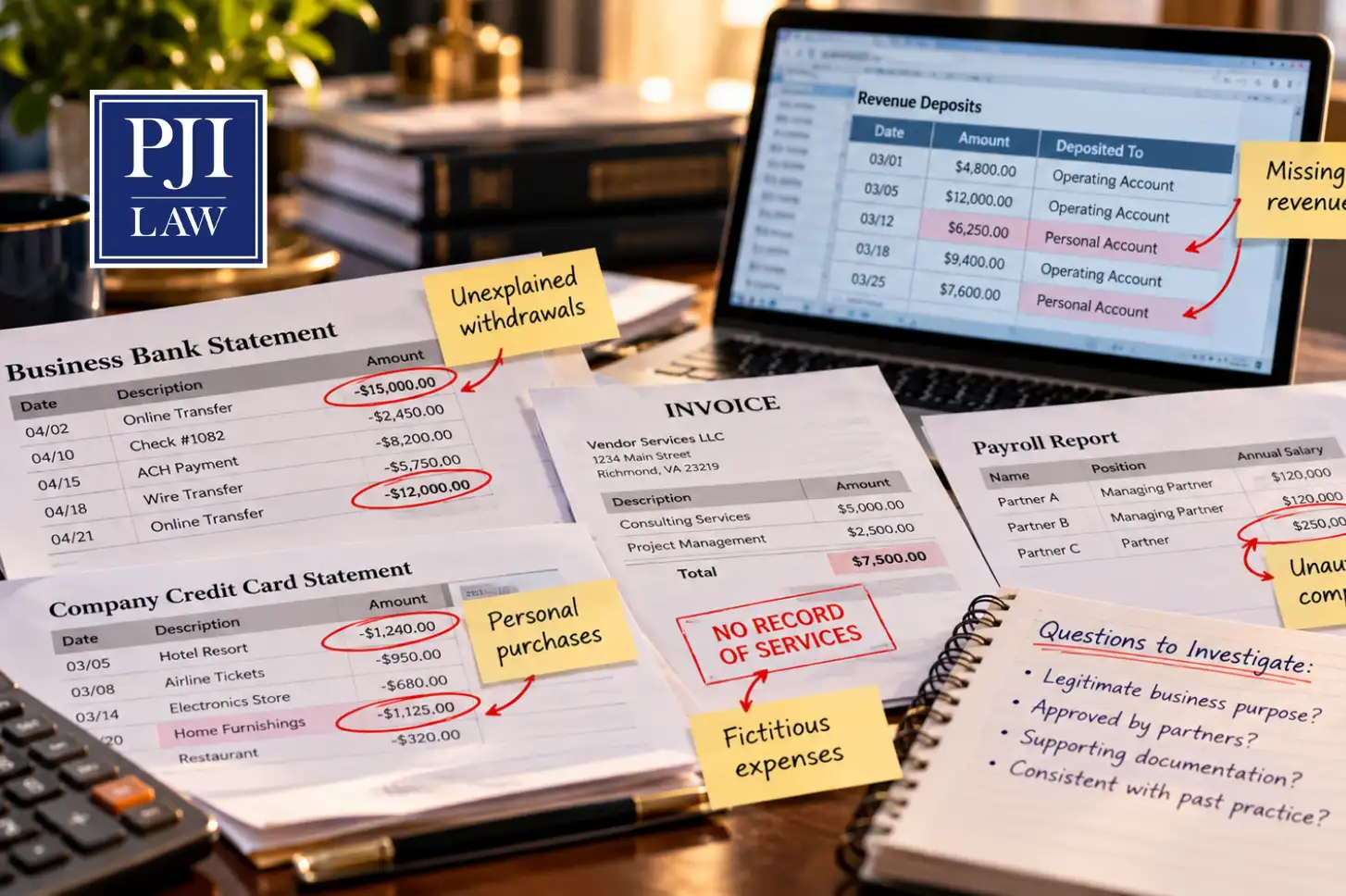
Misappropriation occurs when someone improperly uses money or property entrusted to them or under their control. Within a business partnership, it may involve diverting company assets for personal gain, concealing transactions, or using business resources without the required authorization.
The difficulty is that business partners often have legitimate access to the same accounts. A partner may be authorized to pay vendors, reimburse expenses, receive compensation, or take distributions. The fact that money left the account doesn’t necessarily establish wrongdoing.
The circumstances surrounding each transaction determine whether it raises a legitimate concern.
Common warning signs of financial misconduct
Potential warning signs include:
- Unexplained withdrawals: Transfers to personal accounts or unfamiliar recipients without supporting documentation.
- Personal purchases: Company credit cards used for vacations, household purchases, or other expenses unrelated to the business.
- Missing revenue: Customer payments deposited into an account that doesn’t belong to the company.
- Fictitious expenses: Payments to nonexistent vendors or invoices for services never performed.
- Unauthorized compensation: Bonuses, salary increases, or distributions inconsistent with governing agreements.
- Concealed transactions: Altered bookkeeping entries, missing receipts, or repeated refusal to explain significant payments.
These activities may indicate partnership fraud, but they can also have explanations that aren’t immediately apparent from the records.
For example, a $15,000 transfer to your partner’s personal account might be an unauthorized withdrawal. It could also represent repayment of a documented loan your partner made to the business.
Before drawing conclusions, compare the transaction with the company’s agreements, accounting records, and prior financial practices.

What Should You Do If You Suspect Your Business Partner Is Taking Money?
Discovering possible financial misconduct can create pressure to act immediately. You may want to confront your partner, remove access to the accounts, or demand repayment. Those reactions are understandable, but acting without sufficient information could interfere with an investigation or expose you to legal liabilities.
A more effective approach begins with preserving evidence and determining what actions you’re authorized to take.
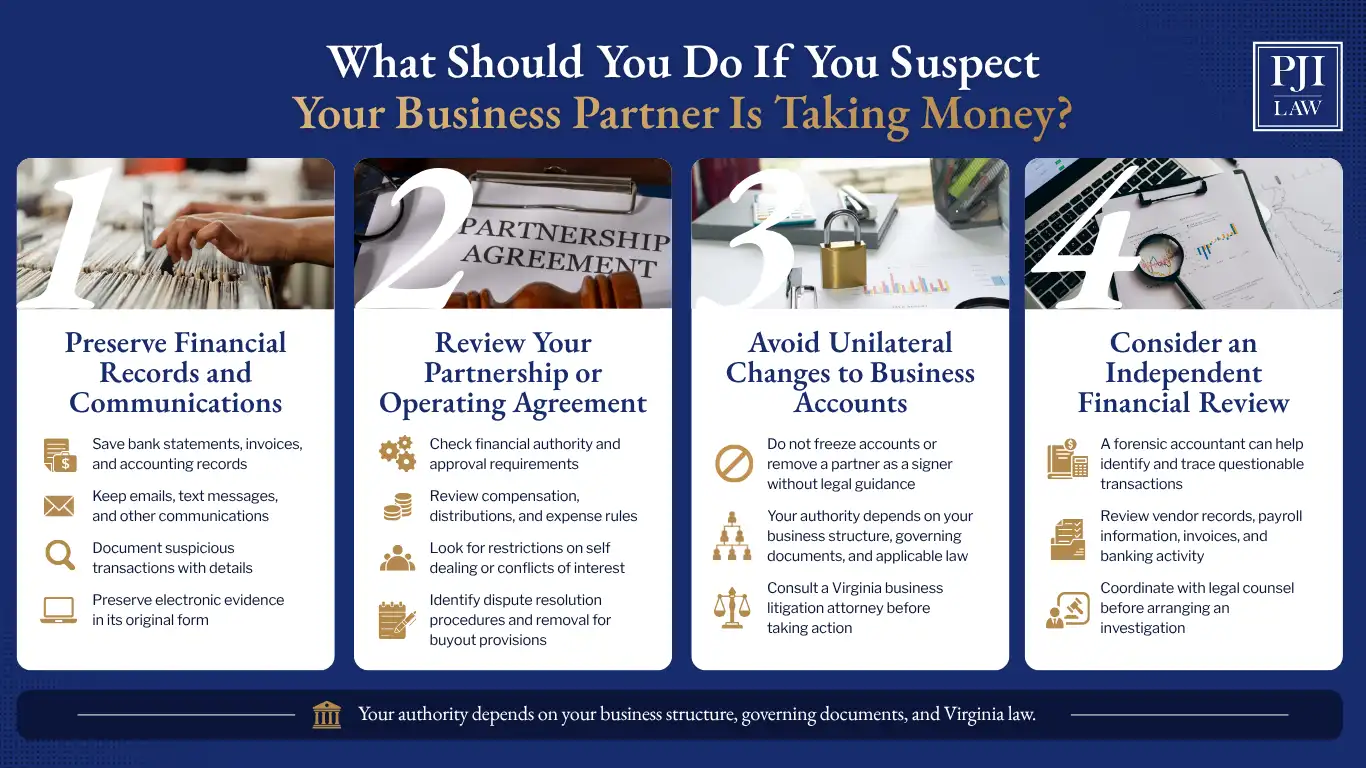
1. Preserve financial records and communications
Start with documents you already have lawful access to, including:
- Business bank statements and canceled checks
- Company credit card statements
- General ledgers and accounting software reports
- Invoices, receipts, and vendor payment histories
- Payroll records and compensation agreements
- Emails, text messages, and other financial communications
- Tax returns and financial statements
Compare the transactions against legitimate business expenses, approved distributions, and your company’s established accounting procedures.
Create a chronological record identifying each questionable transaction, its date, amount, recipient, and the reason it concerns you. Note whether supporting documents are missing or inconsistent.
Preserve relevant electronic evidence in its original form when possible. Downloading an accounting report may be helpful, but retaining available audit trails and transaction histories can provide additional context.
Avoid altering records, deleting communications, or accessing accounts beyond your legal authority. You don’t need to prove that your partner committed fraud before consulting an attorney. An organized record of suspicious activity can help counsel assess whether further investigation is warranted.
2. Review your partnership or operating agreement
Your governing documents may explain who controls the company’s finances and what approvals are required.
Review provisions addressing:
- Authority to withdraw or transfer money
- Compensation, reimbursements, and profit distributions
- Access to financial information
- Restrictions on self dealing or conflicts of interest
- Procedures for addressing misconduct
- Dispute resolution procedures, including mediation or arbitration
- Removal, buyout, and dissolution provisions
A written partnership agreement may give one partner broad authority over financial operations while requiring approval from the other partners for certain transactions.
An LLC operating agreement may establish different management responsibilities and financial controls. These distinctions affect whether your partner’s actions exceeded their authority and what remedies may be available.
3. Avoid unilateral changes to business accounts
You may be tempted to freeze the company’s bank accounts, remove your partner as an authorized signer, or redirect incoming payments.
Before taking those steps, consult a Virginia partnership dispute attorney. Your authority depends on the business structure, bank agreements, governing documents, and applicable law. Restricting another owner’s access without authorization could create a separate dispute or interfere with legitimate business obligations.
An attorney can evaluate whether immediate protective measures are appropriate and how to pursue them lawfully.
4. Consider an independent financial review
When transactions are numerous or difficult to trace, a forensic accountant may help reconstruct the company’s finances. Unlike a routine financial review, forensic accounting focuses on identifying discrepancies, following money through multiple accounts, and documenting findings that may be relevant to a dispute.
An accountant may compare vendor records, payroll information, invoices, and banking activity to determine whether company funds were diverted. Coordinate with legal counsel before arranging an investigation, particularly when questions arise about access to confidential records, preservation of evidence, or the scope of the review.
Can You Demand Access to Your Business Partner’s Financial Records?
Your ability to inspect business records depends partly on how the company is organized. Virginia law distinguishes general partnerships, limited partnerships, LLCs, and corporations. Although owners may informally call one another partners, their legal rights are not interchangeable.
Financial information rights in a general partnership
Under Virginia Code § 50-73.101, partners have statutory rights to access partnership books and records and obtain certain information concerning the partnership’s business and affairs.
The statute addresses access to records maintained by the partnership and information reasonably required to exercise a partner’s rights and duties. It also provides for additional information on demand, subject to statutory qualifications.
If another partner controls the accounting system, these rights may provide a basis for requesting records needed to investigate questionable transactions.
Financial information rights in a Virginia LLC
For LLC members, Virginia Code § 13.1-1028 provides rights to inspect specified company records and request information about the business and its financial condition.
The statute addresses access to financial statements, tax returns, operating agreements, and other information. However, certain information rights may be restricted through a qualifying written operating agreement.
A member who is denied access should have an attorney examine the agreement, the records requested, and the reasons given for refusing access. If your company is a corporation or limited partnership, different statutory provisions may apply.
A refusal to provide information doesn’t automatically establish business partner fraud. However, it may warrant closer examination when accompanied by unexplained transactions or inconsistent financial reporting.
When Does Misappropriation Become a Breach of Fiduciary Duty?
A fiduciary duty is a legal obligation requiring someone to act according to specified standards when handling another person’s or entity’s interests. In a business relationship, those obligations depend on the entity structure, the person’s role, and the governing documents.
Duties of partners in Virginia general partnerships
Under Virginia Code § 50-73.102, partners in a general partnership owe the partnership and other partners duties of loyalty and care. The duty of loyalty includes obligations to account for certain benefits obtained through partnership activities or partnership property, refrain from specified adverse-interest transactions, and avoid competing with the partnership before dissolution.
The duty of care addresses grossly negligent or reckless conduct, intentional misconduct, and knowing violations of law. The statute also requires partners to discharge their duties and exercise their rights consistently with the obligation of good faith and fair dealing.
These requirements are relevant when a partner uses partnership assets for personal gain, conceals a conflicting transaction, or diverts business opportunities. For example, a partner who secretly directs company customers to a separate business they own may raise questions about loyalty, competition, and the improper use of partnership opportunities.
However, Virginia law also recognizes that a partner doesn’t violate a duty merely because an action furthers that partner’s own interests. The relevant question is whether the conduct violates a specific legal or contractual obligation.
What about LLC members and managers?
Not every LLC member has the same obligations as a partner in a general partnership. Management arrangements, statutory provisions, operating agreements, and the person’s actual role can affect whether a fiduciary duty exists and what conduct violates it.
A breach of fiduciary duty claim in Virginia involving an LLC therefore requires a separate analysis rather than automatically applying the rules governing general partnerships. An attorney can determine which duties apply, whether they were breached, and who has the right to pursue the resulting claim.

Can You Sue a Business Partner for Fraud or Misappropriation?
Yes, legal action may be available when the evidence establishes a recognized cause of action. However, the appropriate claim depends on what happened, the duties involved, and whether the misconduct harmed you personally or the business.
A single series of unauthorized transactions may raise several legal issues without satisfying the requirements of every possible claim. These disputes may involve commercial litigation, particularly when allegations of fraud, breached fiduciary duties, or other business-related misconduct arise.
Breach of fiduciary duty
A breach of fiduciary duty claim may arise when someone violates an applicable fiduciary obligation and causes legally recognized harm. For a general partnership, the statutory duties discussed above provide an important starting point.
Evidence may include unauthorized transactions, concealed financial benefits, or misuse of partnership property. The claim must still establish the relevant duty, breach, causation, and damages or other available relief.
Breach of contract
If your partner violated an enforceable financial provision in a partnership agreement or operating agreement, a breach of contract claim may be available.
For example, the agreement might require both owners to approve expenditures exceeding a specified amount. Repeated transfers made without the required approval could support a contractual claim, depending on the agreement and surrounding circumstances.
The legal analysis should distinguish a contractual obligation from an independent fiduciary duty.
Fraud
Partnership fraud may involve intentional deception designed to induce another person to act or refrain from acting to their detriment. Suppose a business partner deliberately falsifies financial statements to conceal diverted revenue, and another owner relies on those statements when making a financial decision. Those circumstances may warrant evaluating a fraud claim.
However, proof that a business partner committed fraud requires more than showing an unexplained withdrawal or dishonest behavior. Virginia fraud claims have specific legal elements, including a qualifying misrepresentation or concealment, intent, reliance, and resulting damage. A claim based only on failure to fulfill a contractual promise may present additional legal obstacles.
Conversion
Conversion concerns the wrongful exercise of control over property belonging to another. In some circumstances, misappropriated money may support a conversion claim when identifiable funds are involved. A general disagreement about money owed under a contract does not automatically qualify. An attorney can evaluate whether the property and conduct satisfy Virginia’s requirements.
Does the claim belong to you or the company?
This distinction can determine how a lawsuit must proceed. If your business partner diverted $50,000 from an LLC’s account, the immediate financial loss may belong to the LLC rather than to you individually.
Virginia law provides procedures for certain derivative lawsuits, in which an eligible member pursues a claim on behalf of the company. Under Virginia Code § 13.1-1042, a member ordinarily must make a written demand on the LLC and wait 90 days before commencing a derivative proceeding. The statute provides exceptions when the demand is rejected earlier or waiting would cause irreparable injury to the LLC.
The statute also imposes requirements concerning the member’s ability to represent the company’s interests. By contrast, a direct claim may be appropriate when the owner has suffered a legally distinct personal injury. Determining who suffered the harm and who owns the claim should happen before filing suit.
What Legal Remedies Can Help Recover Misappropriated Money?

Discovering financial misconduct doesn’t necessarily mean your business partnership must end. Depending on the circumstances, you may be able to pursue financial recovery, negotiate corrective measures, or seek court intervention while the business continues operating.
An accounting of partnership finances
A partnership accounting can help identify money received, payments made, distributions taken, and amounts potentially owed. For general partnerships, Virginia Code § 50-73.103 permits specified actions by partnerships and partners, including certain claims for legal or equitable relief with or without an accounting.
A court-ordered accounting may be appropriate when financial transactions are disputed and the applicable legal requirements are satisfied. An accounting can help establish the financial position of the business, but it doesn’t automatically prove that theft or fraud occurred.
If the dispute proceeds to litigation, the discovery process in a Virginia civil lawsuit may provide additional opportunities to collect relevant financial records and other evidence.
Monetary damages and repayment
A successful civil claim may permit recovery of compensatory damages for proven losses. Depending on the cause of action and evidence, the financial losses might include diverted money, improper payments, or lost profits attributable to the misconduct.
The available measure of damages depends on the claim, and losses must be established with sufficient certainty. Punitive damages may be available in limited circumstances involving qualifying misconduct, but they are not automatically recoverable whenever a business partner committed fraud or breached a duty.
Injunctive relief to prevent further harm
When misconduct is ongoing, an attorney may evaluate whether temporary injunctive relief is appropriate. Such relief can sometimes restrict particular conduct while litigation proceeds. However, a court doesn’t automatically freeze assets merely because one owner suspects another of wrongdoing.
Virginia courts apply legal requirements to requests for temporary injunctions, and the evidence, urgency, requested restrictions, and potential harm all affect the analysis. Because emergency proceedings can have significant consequences, they should be evaluated promptly with legal counsel.
Negotiated repayment or restructuring
Litigation isn’t the only possible response. Depending on the evidence and the parties’ willingness to cooperate, a negotiated resolution might include repayment, an independent accounting, revised financial controls, or changes to management responsibilities.
Any agreement should address how repayment will occur, who controls future transactions, and what happens if the terms are violated. Where the relationship remains workable, these measures may allow the business to continue without immediately pursuing dissolution.
Can You Remove a Business Partner Who Misappropriated Money?
Financial misconduct may make continued ownership together impractical. Still, removing a business partner is not always as simple as voting them out or changing account access. The available procedures depend on the business entity, governing documents, and applicable Virginia law.
An operating agreement might contain provisions addressing expulsion, buyouts, or management changes. A general partnership may be governed by different rules concerning dissociation and dissolution.
In some circumstances, judicial dissolution may be available when the statutory grounds are established. However, dissolution is not a required first step in every financial dispute, and misconduct doesn’t automatically authorize one owner to take over the company.
Before attempting to remove your partner, consider whether the business can continue, how ownership interests would be valued, and whether the suspected misconduct has affected creditors, employees, or other partners.
PJI’s related blog on removing a member from a Virginia LLC can provide additional information about that separate issue.
Is Misappropriation of Business Funds a Crime in Virginia?
Misappropriation may give rise to civil claims, criminal charges, or both, depending on the conduct and available evidence. Under Virginia Code § 18.2-111, embezzlement involves the wrongful and fraudulent use, disposal, concealment, or appropriation of certain property received or entrusted to a person under circumstances covered by the statute.
A business partner who intentionally diverts entrusted company money may engage in conduct warranting investigation under this provision. However, an unauthorized transaction does not automatically establish criminal embezzlement. The required elements must be proven.
Civil litigation and criminal proceedings serve different purposes. A civil claim may seek financial recovery or other relief, while a criminal prosecution concerns alleged violations of criminal law. You can consult a civil litigation attorney about your legal options even if no criminal charges have been filed.
If you believe criminal conduct occurred, counsel can also advise you about the implications of reporting the suspected misconduct to law enforcement.

Frequently Asked Questions
Can I sue my business partner for taking money without permission?
Potentially. If your partner took company money without authorization, the circumstances may support claims involving breach of fiduciary duty, breach of contract, conversion, or fraud. The appropriate claim depends on your business structure, the evidence, and whether the loss belongs to you or the company.
What if my business partner refuses to provide financial records?
Virginia law provides certain information and inspection rights to general partners and LLC members. The scope of those rights depends on the entity structure, governing documents, and applicable statutes. An attorney can evaluate whether a formal records request or court proceeding is appropriate.
Can I freeze the business bank account if I suspect theft?
Not necessarily. Your authority to restrict account access depends on bank arrangements, company agreements, and applicable law. Unilateral action could interfere with business operations or violate another owner’s rights. Obtain legal advice before changing access or redirecting funds.
Do I need proof of fraud before contacting a lawyer?
No. You can consult an attorney when you discover unexplained transactions, missing money, inconsistent financial statements, or restricted access to records. An attorney can help determine what evidence is needed and how to investigate without exceeding your authority.
Can I recover money my partner spent on personal expenses?
Possibly. Recovery depends on whether the expenditures were unauthorized, who owned the money, which claims are available, and what damages can be proven. A negotiated repayment agreement or civil lawsuit may be appropriate.
Can I remove my partner without dissolving the business?
Sometimes. The answer depends on your entity structure, governing documents, and Virginia law. A negotiated buyout, authorized expulsion, or other restructuring arrangement may be possible. Misconduct alone does not automatically give you authority to remove another owner.
What if my business partner controls all the company accounts?
Review your legal rights to financial information before attempting to access restricted systems. Virginia partnership and LLC statutes provide certain records rights, although their scope differs. Counsel can help pursue appropriate information requests and evaluate whether court intervention is necessary.
Is stealing company money considered embezzlement in Virginia?
It can be. Virginia Code § 18.2-111 addresses wrongful and fraudulent conduct involving entrusted property. Whether particular transactions constitute embezzlement depends on the evidence and statutory elements. A civil dispute does not automatically establish a crime.
Can I sue my business partner personally, or must the company sue?
That depends on the nature of the injury and the legal claim. Some losses belong to the company and may require an entity claim or derivative proceeding. Other conduct may cause a distinct personal injury supporting a direct claim. An attorney should evaluate standing before litigation begins.
How long do I have to sue for misappropriation of business funds in Virginia?
Virginia does not impose one universal filing deadline for every misappropriation dispute. The applicable statute of limitations depends on the cause of action, the nature of the injury, and when the claim accrued. Contract, fraud, and fiduciary-duty claims may be governed by different rules. Prompt legal review can help identify applicable deadlines.
Protect Your Business When a Partner’s Financial Conduct Raises Questions
Discovering unexplained withdrawals or missing company money can leave you questioning both your financial security and the future of a business you’ve invested years building. You may be concerned about confronting your partner, protecting employees and customers, or taking legal action that could disrupt operations. Before making decisions that affect the company, you need a clear assessment of your rights and the evidence.
At PJI Law, PLC, our Virginia partnership dispute attorneys represent business owners facing disagreements over financial management, ownership obligations, and suspected misuse of company assets. We can review your governing agreements, financial documentation, and communications to evaluate potential claims and available remedies. When appropriate, we can work with financial professionals to examine disputed transactions and pursue a resolution through negotiation or litigation.
If you suspect your business partner has misappropriated company money, call (703) 865-6100 or contact us online to schedule your complimentary consultation. You don’t need to untangle every transaction before speaking with an attorney.
At PJI Law, you’ll receive white-glove service and personal attention from a team that treats you like family.
Copyright © 2026. PJI Law, PLC. All rights reserved.
The information in this blog post (“post”) is provided for general informational purposes only and may not reflect the current law in your jurisdiction. No information in this post should be construed as legal advice from the individual author or the law firm, nor is it intended to be a substitute for legal counsel on any subject matter. No reader of this post should act or refrain from acting based on any information included in or accessible through this post without seeking the appropriate legal or other professional advice on the particular facts and circumstances at issue from a lawyer licensed in the recipient’s state, country, or other appropriate licensing jurisdiction.
PJI Law, PLC
3900 Jermantown Road, 2nd Floor
Fairfax, VA 22030
(703) 865-6100
