

A Richmond resident leaves a house and its contents to a local church. Although the gift is meaningful, the church’s leaders and volunteers may not have the time, personnel, or knowledge to secure the property, review decades of belongings, hire an appraiser, or oversee a sale. In another estate, a nonprofit beneficiary or the deceased person’s heirs live outside Virginia and cannot repeatedly travel to Richmond to maintain the home, meet vendors, and supervise the administration.
Fiduciary services provide a local point of responsibility for this legal, financial, and practical work. Services may include securing property, coordinating cleanouts and appraisals, hiring vendors, overseeing sales, maintaining financial records, and completing the final distribution.
For churches, nonprofits, and long-distance heirs facing these circumstances, PJI Law provides comprehensive fiduciary services for managing a Richmond estate. The firm can coordinate the legal administration and property-related responsibilities from start to finish. Knowing how these services work, what they include, and how they fit within the Virginia probate process can help an organization or heir determine what support the estate requires.

At a Glance
- Fiduciary services may cover legal administration, financial recordkeeping, property management, vendor coordination, sales, and distributions.
- A personal representative must have proper authority before controlling, selling, or distributing probate property.
- Virginia requires personal representatives to complete specific notices, inventories, accountings, and other filings.
- Churches and nonprofits should evaluate inherited property before accepting responsibility for its expenses, condition, or sale.
- Long-distance heirs can use local professional fiduciary support to manage many responsibilities without making repeated trips to Richmond.
- The personal representative’s authority comes from court qualification, the will, and Virginia law, while the professional engagement defines which fiduciary services the law firm will handle.
What Are Fiduciary Services in Estate Administration?
Fiduciary services provide professional help with managing an estate after someone dies. These services may include protecting property, locating and valuing assets, maintaining financial records, coordinating cleanouts and appraisals, hiring vendors, preparing property for sale, addressing expenses and taxes, and completing distributions.
During estate administration, the personal representative has legal authority to act for the estate. A qualified professional providing fiduciary services may be appointed to serve as the personal representative or may assist someone else who serves in that role. If the professional is not the personal representative, the appointed executor or administrator retains the authority to approve decisions, sign documents, and distribute estate property.
Fiduciary services can be especially helpful when a church, nonprofit, or long-distance heir lacks the time, personnel, or proximity to manage the work. Rather than coordinating each legal filing, property visit, vendor, and financial record independently, the organization or family can obtain local assistance with the responsibilities included in the professional engagement.

Why Can Estate Administration Be Difficult for Churches, Nonprofits, and Long-Distance Heirs?
Estate administration often involves far more than preparing legal documents and completing court filings. Someone must protect the deceased person’s assets, maintain accurate records, and manage the property while the probate process is pending.
A vacant home may require new locks, continued insurance, utility service, lawn care, repairs, mail collection, security monitoring, and protection from weather damage. Contents may need to be inventoried, appraised, stored, sold, donated, or distributed. Each expense and transaction must also be documented for the estate’s accounting.
Distance adds another layer of difficulty. An heir may review documents electronically, but they cannot inspect a house after a storm or admit an appraiser from another state. A charitable organization may have capable directors but no local staff member available to supervise vendors in Richmond.
Professional fiduciary services connect the legal administration with the work taking place at the property. The scope of assistance can be tailored to the estate’s assets, condition, beneficiaries, and location.
What Do Full-Service Fiduciary Services Include?

The services required depend on the estate’s assets, debts, governing documents, beneficiaries, and condition. An estate holding liquid, well-documented assets may require less hands-on administration than one containing multiple properties, private investments, closely held business interests, vehicles, valuable collections, or years of personal belongings.
Full-service fiduciary services go beyond preparing probate paperwork. Depending on the scope of the engagement and the authority granted, a law firm can oversee the practical, financial, and administrative work from securing estate property through final distribution. The personal representative retains authority over decisions reserved to that role unless a qualified professional has been appointed to serve as the personal representative.
Complete fiduciary services may include the following responsibilities:
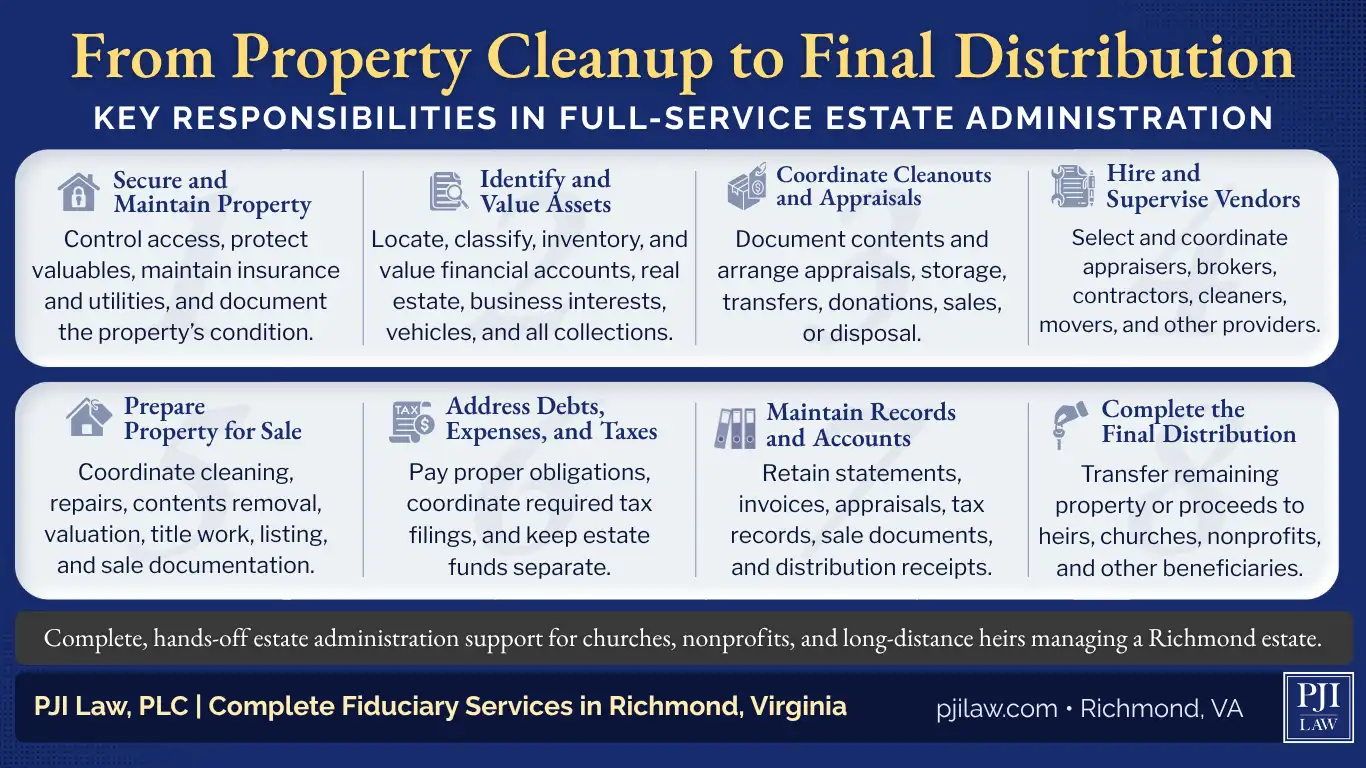
Securing and maintaining estate property
Vacant property can deteriorate quickly. A fiduciary may need to:
- Confirm who has keys or access codes
- Change locks when appropriate
- Locate and protect cash, jewelry, legal documents, and financial records
- Confirm that property and vehicle insurance remain in place
- Notify the insurer when a home becomes vacant
- Maintain necessary utilities and security systems
- Arrange lawn care, cleaning, pest control, or repairs
- Forward mail and monitor notices sent to the deceased
- Document the property’s initial condition
Family members, heirs, and beneficiaries should not remove property before the personal representative confirms who owns it and how it must be handled. Premature removal can cause disputes and make an accurate inventory more difficult.
Identifying and valuing assets
The personal representative must determine what the decedent owned and which assets belong to the probate estate. The review may include financial accounts, multiple real estate holdings, closely held business interests, private investments, vehicles, artwork, jewelry, valuable collections, storage units, safe-deposit boxes, and money owed to the deceased.
However, not every asset passes through probate. A joint account, payable-on-death account, life insurance policy, retirement account, or property held in a living trust may pass under a separate legal arrangement. Correctly classifying the assets affects the inventory, accounting, taxes, and distribution.
Unless an exception or waiver applies, Virginia law requires a personal representative to file an inventory within four months after qualification. The inventory includes covered property under the personal representative’s control and its market value as of the date of death. Reasonable valuation expenses may be treated as an administration cost.
Coordinating cleanouts, storage, and appraisals
Preparing a residence and its contents for transfer, storage, sale, donation, or disposal requires a documented process. Among the belongings may be specifically gifted property, valuable items, family photographs, sensitive records, or documents identifying additional assets.
A structured cleanout may involve:
- Photographing and documenting the contents
- Separating legal and financial records
- Identifying items addressed in the will
- Setting aside property requiring appraisal
- Consulting beneficiaries about sentimental items when appropriate
- Arranging secure storage
- Selecting property for sale, donation, transfer, or disposal
- Retaining records of the decisions and expenses
A local fiduciary can meet vendors, answer questions, and document how the contents were handled without requiring beneficiaries or organizational representatives to attend each appointment.
Hiring and supervising vendors
An estate may require assistance from specialized appraisers, auction houses, estate-sale professionals, real estate brokers, property managers, contractors, cleaners, movers, locksmiths, landscapers, storage companies, accountants, and tax preparers.
The fiduciary should review each vendor’s role, fees, insurance, and proposed scope of work. Contracts, invoices, receipts, and sale records must be retained. Centralized coordination can also reduce missed appointments, duplicated services, and uncertainty about who approved an expense.
Preparing property for sale
Real estate may require cleaning, repairs, removal of personal property, valuation, or title work before it can be listed. The personal representative must also confirm the authority to sell.
That authority can depend on how title was held, the language of the will, whether the property belongs to the probate estate, outstanding liens, and the purpose of the proposed sale. The rights of a surviving spouse or other interested person may also affect the decision.
Sale proceeds must be deposited and documented as estate assets. They should not be distributed until the personal representative has accounted for debts, taxes, filing requirements, and other obligations.
Addressing debts, expenses, and taxes
A personal representative identifies and addresses proper estate obligations before distributing the remaining assets. These obligations may include funeral expenses, property costs, administration fees, valid creditor claims, and taxes.
The personal representative may need to obtain an employer identification number and open an estate account. Estate money should remain separate from the personal representative’s personal funds or a beneficiary organization’s operating accounts.
Tax responsibilities may include:
- The deceased person’s final individual income tax return
- A federal estate income tax return on Form 1041
- A Virginia fiduciary income tax return
- A federal estate tax return on Form 706 when required
The IRS requires an estate income tax return for a domestic decedent’s estate with gross income of $600 or more during the tax year, among other filing circumstances. For 2026, the federal basic exclusion amount is $15 million, although prior taxable gifts and portability can affect the filing analysis.
An estate that owes no federal estate tax may still file Form 706 to elect portability of a deceased spouse’s unused exclusion. Virginia does not impose an inheritance tax merely because a beneficiary receives an inheritance, but other tax consequences may depend on the property and income earned during administration.
Maintaining records and completing fiduciary accounts
Virginia’s Commissioner of Accounts reviews inventories and accounts filed by personal representatives. Under Virginia Code § 64.2-1304, the first account is due within 16 months after qualification and reports the money and property received or disbursed during the first 12 months.
Bank statements, invoices, canceled checks, sale documents, appraisals, tax records, and distribution receipts may be needed to support the accounting. Complete records help beneficiaries understand how the estate was managed and allow the personal representative to respond to questions or objections.
Completing the final distribution
The personal representative can complete the final distribution after identifying the beneficiaries or heirs, addressing appropriate obligations, completing required filings, and determining what remains. A valid will controls the distribution when one exists. If the person died intestate, Virginia’s intestacy laws determine who inherits.
A church or nonprofit might receive a specific amount, a percentage of the remaining estate, identified property, real estate, trust distributions, or sale proceeds. Before the gift is distributed, the organization’s legal name, tax identification information, authorized recipient, and delivery instructions should be confirmed.
The infographic below summarizes how these responsibilities fit together, from securing and maintaining estate property through final distribution.
How Do Fiduciary Services Fit Into the Virginia Probate Process?
Probate is the legal process for admitting a will, qualifying a personal representative, administering probate assets, and transferring the remaining property to beneficiaries or heirs. In Virginia, the circuit court clerk and Commissioner of Accounts oversee different parts of the administration.
Fiduciary services can support the administration at each stage of the Virginia probate process. The scope of the engagement determines whether a qualified professional serves as the personal representative or assists a separately appointed executor or administrator with the estate’s legal, financial, and property-related responsibilities.
A Virginia probate proceeding may include the following steps:
- Determine the proper jurisdiction. A will is offered for probate in the circuit court for the city or county where the decedent had a known place of residence.
- Locate and present the will. If the decedent left a valid will, it is presented for probate. If the decedent died intestate, an eligible person may seek appointment as administrator.
- Qualify the personal representative. An executor named in a will does not receive full authority merely from being named. The person must qualify, take the required oath, and provide any required bond or surety.
- Provide required notice. Virginia law requires the personal representative or proponent of the will to send notice to specified parties within 30 days after qualification or admission of the will to probate.
- Identify and secure estate assets. The personal representative identifies, collects, and protects probate assets within the scope of the appointment and determines their date-of-death values. Fiduciary services may include securing a residence, locating records, confirming insurance coverage, arranging appraisals, and coordinating the inventory of personal property.
- File the inventory. The inventory is ordinarily due within four months after qualification. Property documentation, account records, and appraisals provide the information needed to prepare the inventory.
- Address expenses, claims, and taxes. The personal representative evaluates and pays proper obligations in the legally applicable order. Fiduciary services may include maintaining financial records, organizing invoices and creditor information, coordinating tax filings, and documenting payments.
- File the accounting. The accounting documents receipts, expenses, sales, distributions, and property still held. Complete records of maintenance, vendors, appraisals, sales, and other transactions support the required fiduciary accounts.
- Distribute the remaining property. Once the estate is ready, the personal representative transfers the remaining assets to the beneficiaries or heirs. Fiduciary services can help coordinate property transfers, confirm beneficiary information, collect distribution receipts, and complete the remaining administrative work.
Fiduciary services connect the court-supervised requirements of probate with the financial and property-related work required to complete the administration. This support can be particularly valuable when an estate contains multiple properties, closely held businesses, private investments, valuable collections, deferred maintenance, or beneficiaries who cannot manage the work locally.
How Can Fiduciary Services Help Churches and Nonprofits?

A gift of real estate can be valuable to a church or nonprofit while also creating immediate responsibilities. The property may have a mortgage, deferred maintenance, unpaid taxes, tenants, valuable contents, environmental concerns, or insurance issues. The organization may operate outside Virginia or lack staff familiar with Virginia probate administration.
A vacant or deteriorating property may also present safety and insurance risks, making prompt inspection, appropriate coverage, controlled access, and necessary maintenance important while the estate is being administered.
Before accepting or directing the handling of a gift, organizational leaders should determine:
- What the will or trust gives the organization
- Whether it will receive the property or the sale proceeds
- Who has legal authority over the property
- Whether the organization has a gift-acceptance policy
- Who can approve the gift and sign documents
- What debts and ongoing expenses accompany the property
- Whether restrictions affect the property’s use or sale
- Whether accepting the gift is consistent with the organization’s mission and internal policies
Being named as a beneficiary does not make the church or nonprofit the personal representative. Its leaders, employees, or volunteers should not enter the property, remove belongings, hire vendors, or agree to a sale without confirming who has authority to act.
Instead, a law firm providing fiduciary services can collect information for the organization’s decision-makers, maintain the property, coordinate appraisals and vendors, document expenses, and oversee a sale when authorized. This arrangement allows the organization to receive and evaluate the gift without assigning staff members or volunteers to manage each task in Richmond.
How Can Long-Distance Heirs Manage a Virginia Estate?
Living outside Virginia does not automatically prevent you from participating in estate administration or serving as a personal representative. A remote appointment can still create legal and logistical complications.
You may be able to review documents, attend meetings, approve work, and communicate with beneficiaries electronically. Local tasks still require someone to inspect the property, meet appraisers and contractors, locate records, supervise a cleanout, monitor repairs, and coordinate a sale.
Professional fiduciary services can reduce repeated travel while keeping you informed. A communication plan may include scheduled updates, photographs, vendor proposals, expense reports, and copies of important filings.
Remote administration does not mean you give up every decision. The engagement should explain which decisions remain with the appointed personal representative, which responsibilities PJI Law would manage, and when additional approval is required.

What Should You Ask Before Hiring Fiduciary Services?
Before engaging a law firm for fiduciary services, determine whether its assistance extends beyond probate paperwork. Confirm who has legal authority to act for the estate, which decisions require the personal representative’s approval, and which responsibilities the law firm will manage.
Churches, nonprofits, and long-distance heirs may benefit from complete, hands-off estate administration support when they lack the time, proximity, or resources to manage an estate themselves. Ask whether the services include protecting and maintaining property, coordinating cleanouts and appraisals, supervising vendors, preparing property for sale, maintaining financial records, and assisting with final distribution. If the estate includes a home, determine whether the law firm will coordinate the property and its contents or whether those responsibilities will remain with the beneficiaries or organization.
You should also ask how vendors will be selected, how legal fees and outside expenses will be calculated, how you will receive updates, and what will happen if a dispute develops. A written scope of services establishes who will handle each responsibility and which decisions require additional approval.
Frequently Asked Questions About Fiduciary Services
What are professional fiduciary services for an estate?
Professional fiduciary services provide assistance with the legal, financial, and practical responsibilities of estate administration. A qualified professional may serve as the personal representative or support a separately appointed executor or administrator. Services may include protecting property, maintaining financial records, coordinating vendors, preparing filings, overseeing sales, and completing distributions.
Can an attorney serve as an executor or administrator in Virginia?
An attorney may serve if properly nominated or appointed and qualified under Virginia law. Hiring an attorney to represent the estate does not automatically make that attorney the personal representative.
Can I administer a Virginia estate if I live in another state?
A nonresident may be able to serve, but additional qualification, bond, resident-agent, or procedural requirements may apply. The estate’s location and complexity also affect whether remote administration is practical.
Must an out-of-state heir travel to Richmond for probate?
Not every task requires an in-person visit. Many communications and document reviews can occur remotely. Whether you must travel depends on your role, qualification requirements, court procedures, and the condition of the estate property.
What happens when a church or nonprofit inherits a house?
The organization should confirm the terms of the gift, who controls the property during administration, the building’s condition, ongoing expenses, title issues, and its own gift-acceptance procedures. It can then decide whether accepting the property or receiving sale proceeds is appropriate.
Who pays for cleanouts, appraisals, maintenance, and estate sales?
Authorized and reasonable expenses may be paid from estate assets when they are proper administration costs. The personal representative should retain contracts, invoices, receipts, and proof of payment for the accounting.
Can a professional fiduciary sell estate property?
A fiduciary may sell estate property when the fiduciary has the required authority. That authority can depend on title, the will, court qualification, Virginia law, and the nature of the proposed sale.
How long does estate administration take in Virginia?
The timeline for estate administration depends on the property, creditor issues, taxes, required filings, disputes, and whether assets must be sold. An estate containing a house and substantial personal property can take longer than an estate holding only accessible financial accounts.

Trusted Fiduciary Services for Churches, Nonprofits, and Long-Distance Heirs
Complete Fiduciary Services from Property Cleanup to Final Distribution
A gift left through an estate can carry deep personal meaning. A longtime member may leave a home to the church that supported them. A donor may remember a nonprofit whose work shaped their life. A relative may leave you property in Richmond while you live hundreds or thousands of miles away.
Honoring that gift can require someone to protect the property, sort and value its contents, supervise vendors, maintain financial records, complete the probate filings, and prepare the remaining assets for distribution. Those responsibilities can quickly exceed the time and resources available to a family member or charitable organization.
PJI Law, PLC provides complete, hands-off estate administration support for churches, nonprofits, and long-distance heirs. Our Richmond estate administration attorneys can manage the legal and practical details, including property protection, cleanouts, appraisals, sales, vendor coordination, financial records, and final distribution. Our goal is to provide peace of mind by managing the details efficiently, professionally, and respectfully while helping make sure the estate is properly administered from start to finish.
Call (804) 653-3450 to schedule your complimentary consultation. You can also complete our confidential online form if that is more convenient.
At PJI Law, you’ll receive white-glove service and personal attention from a team that treats you like family.
Copyright © 2026. PJI Law, PLC. All rights reserved.
The information in this blog post (“post”) is provided for general informational purposes only and may not reflect the current law in your jurisdiction. No information in this post should be construed as legal advice from the individual author or the law firm, nor is it intended to be a substitute for legal counsel on any subject matter. No reader of this post should act or refrain from acting based on any information included in or accessible through this post without seeking the appropriate legal or other professional advice on the particular facts and circumstances at issue from a lawyer licensed in the recipient’s state, country, or other appropriate licensing jurisdiction.
PJI Law, PLC
4108 E Parham Road
Richmond, VA 23228
(804) 653-3450
https://www.pjilaw.com/
