


Losing a parent is one of life’s most difficult experiences. While you’re trying to process your loss, family members may already be asking questions, bills still need attention, and legal responsibilities can begin piling up. If you’ve been named the executor of your parent’s will, you’re now responsible for guiding your parent’s estate through Virginia’s probate process. If you’ve never served in this role before, it’s normal to wonder where to begin.
Fortunately, you don’t have to figure everything out at once. The probate process in Virginia follows a structured path, and understanding what comes first can help you avoid common mistakes while moving the estate forward. Taking one step at a time often makes the responsibilities ahead feel much more manageable.
Knowing what to expect can make a difficult time a little less overwhelming. From qualifying with the probate court to paying debts, communicating with beneficiaries, and distributing estate assets, understanding your responsibilities as the executor of a will can help you administer your parent’s estate with confidence during this difficult time.

At a Glance
- Before you have legal authority to administer the estate, you’ll generally need to qualify with the Clerk of the Circuit Court where your parent lived.
- You’ll need to gather important documents, protect estate assets, provide required notice to heirs and beneficiaries, and address creditor claims as part of the probate process.
- As executor, you’ll have a fiduciary duty to protect the estate, follow the terms of the will and Virginia law, and keep careful financial records.
- Before you can distribute estate assets, you must pay valid estate debts, taxes, and administration expenses.
- Many estates can be settled in less than a year, although more complex estates may take longer.
- An experienced estate administration attorney can help if questions arise during estate administration or if disputes develop.
First, Take a Breath: You Don’t Have to Make Every Decision Today
When a parent dies, it’s natural to feel pressure to start handling paperwork immediately. Family members may ask questions about inheritances, creditors may begin contacting the family, and financial institutions may request documentation before discussing accounts. While there are important deadlines, very few decisions need to be made within the first few hours or even the first few days.
One of the biggest mistakes a named executor can make is rushing to distribute property or close accounts before understanding the legal process. Until you’ve officially qualified through the court, your authority to act on behalf of the deceased person’s estate is limited.
Instead of trying to solve every issue at once, focus on taking the next appropriate step. The probate process in Virginia is designed to move through each stage in order, giving you time to gather information before making major decisions.

Your Decisions During the First Week
The days immediately following your parent’s death often involve practical matters that have little to do with formal executor authority. These are things you can start on right away, before you’ve gone through the court process that gives you legal authority over the estate, covered in the next section.
Obtain Multiple Certified Copies of the Death Certificate
Nearly every organization you’ll work with, including banks, life insurance companies, government agencies, investment firms, and financial institutions, will request a certified death certificate before releasing information or transferring ownership.
Make sure the copies you order have the official raised or embossed seal, since some institutions won’t accept plain photocopies or uncertified printouts. Ordering multiple certified copies upfront can save time later.
Locate the Original Will and Other Important Documents
If your parent left a valid will, locate the original signed document rather than relying on copies whenever possible. You’ll also want to gather documents related to:
- Bank accounts
- Brokerage accounts
- Retirement plans
- Investment accounts
- Real estate
- Vehicle titles
- Insurance policies
- Business records
- Recent tax returns
- Outstanding bills
Having these records available early can make the probate process much smoother.
Secure Your Parent’s Home and Belongings
If your parent owned a home, vehicle, or other valuable personal property, take reasonable steps to secure it. That may include changing locks if necessary, forwarding mail, maintaining insurance coverage, or arranging for ongoing maintenance until ownership is transferred. You don’t need to begin distributing belongings right away. Instead, focus on preserving the property’s value for everyone with an interest in the estate.
Under Virginia Code § 64.2-511, Virginia law also allows a named executor to take a narrow set of actions even before qualifying with the court: arranging burial, paying reasonable funeral expenses, and taking steps to preserve the estate from waste. Beyond that, most of what you handle in the first week falls to you as a family member helping out, not as the legally authorized executor. That authority comes next.
Qualifying as the Executor
You might assume you’re automatically authorized to act as soon as your parent passes away, but that’s not the case. Virginia requires most executors to complete a court process before receiving official authority over the estate.
One note on terminology: Virginia law and many court forms use the broader term “personal representative.” An executor is a personal representative named in a will, so you’ll often see both terms used throughout the probate process. Since your parent left a will naming you for this role, you’re serving as the executor while also acting as the estate’s personal representative.
Acting on behalf of the estate covers things like opening an estate bank account, accessing your parent’s financial accounts, paying bills from estate funds, selling or transferring property, and dealing with creditors and financial institutions on the estate’s behalf. Until you’ve qualified, you generally can’t do any of this. That authority only takes effect once the court confirms you as executor.
How to Qualify in Richmond
In Richmond, probate and qualification are generally handled before the Clerk of the Circuit Court serving the locality where the deceased person lived at the time of death. To qualify, you’ll generally present the original will, a certified death certificate, required probate forms, and any additional documentation requested by the Clerk of Court.
Once you’ve qualified, the Clerk of the Circuit Court issues a Certificate of Qualification (also referred to as a letter of administration) that serves as official proof of your authority to act on behalf of the decedent’s estate. Financial institutions and others often request this certificate before allowing you to access estate accounts, transfer assets, or conduct other business on the estate’s behalf.
What to Know About the Bond Requirement
A bond is a financial guarantee that helps protect the estate and its beneficiaries if an executor fails to carry out their legal responsibilities properly.
As part of qualifying, Virginia law requires an executor to provide a bond. The Clerk of the Circuit Court determines the amount of the bond and whether additional security is required under Virginia law. In some instances, the bond may be waived.
Can You Decline to Serve as Executor?
Being named as the executor in your parent’s will doesn’t require you to accept the role. If you don’t wish to serve, you may decline the appointment before qualifying with the Clerk of the Circuit Court. If the will names an alternate executor, that person may qualify instead. Otherwise, the court may appoint another qualified personal representative to administer the estate.
After You Qualify: What Comes Next?
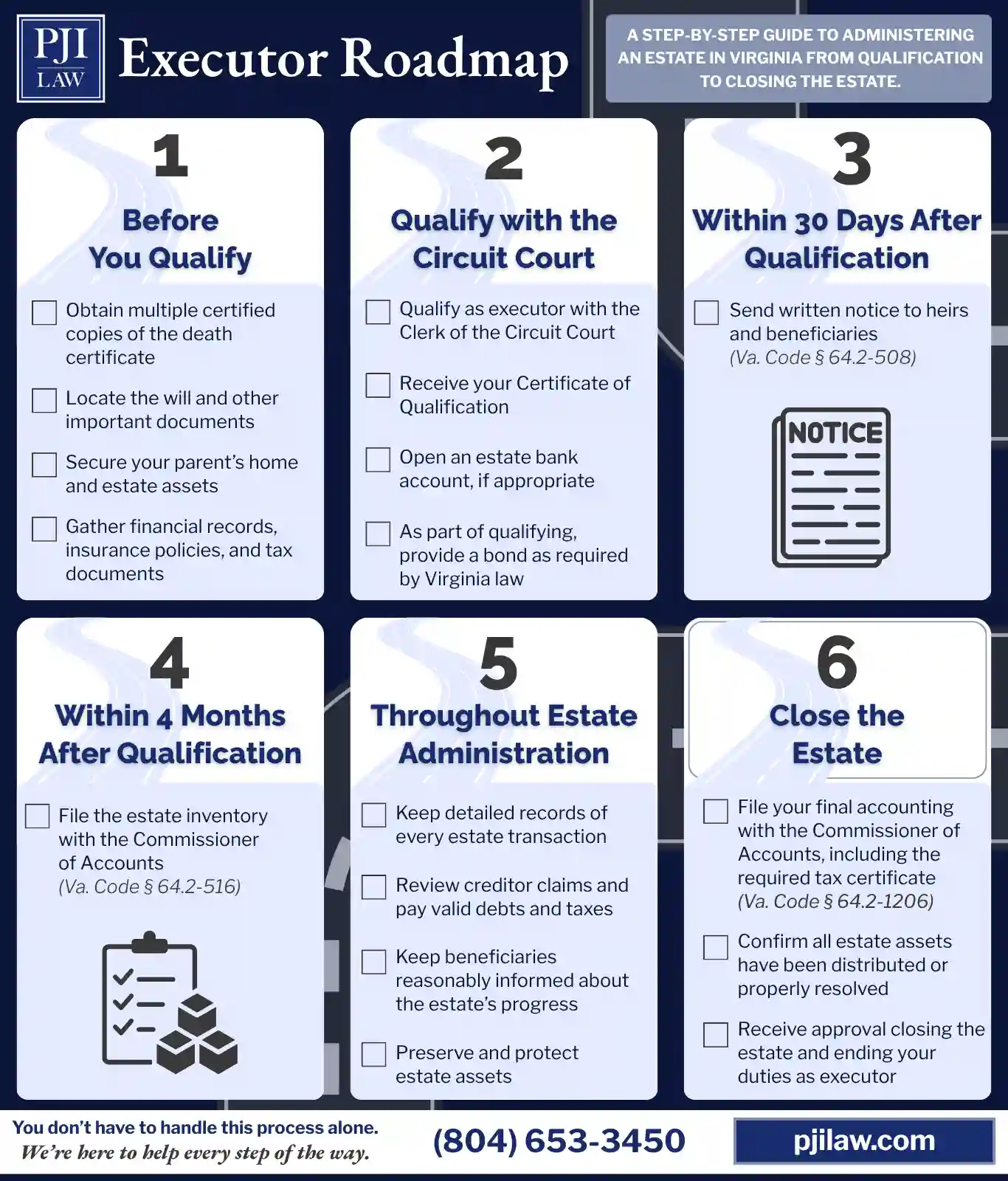
After qualification, the probate process officially begins, and several important deadlines start running. One of your first responsibilities is notifying the appropriate people that probate has been opened.
Under Virginia Code § 64.2-508, the executor must provide written notice to heirs and beneficiaries within 30 days after qualification. You may also need to notify creditors so they have an opportunity to present valid claims against the estate.
At this stage, you’re acting on behalf of the estate, not yourself or any individual beneficiary. That means decisions should be based on your legal responsibilities rather than family expectations or personal preferences.
Protecting the Estate
One misconception is that an estate executor simply distributes inheritances. In reality, your first responsibility is protecting the estate until it can be properly administered. Once you’re qualified, protecting the estate becomes a formal legal responsibility, not just the practical steps you may have already taken to secure your parent’s home and belongings.
Virginia law imposes a fiduciary duty on every executor. A fiduciary duty means you must act honestly, carefully, and in the interests of the beneficiaries while following the terms of the will and applicable state law.
As the executor, you’re responsible for protecting the decedent’s assets, maintaining accurate financial records, and making decisions that benefit the estate rather than yourself. That duty continues throughout the entire probate process, and two habits will carry you through most of it: keeping estate money separate from your own, and keeping a clear record of everything you do.
Separate Estate Funds From Your Own
One of the simplest ways to avoid problems is keeping estate funds completely separate from your personal finances. Many executors open an estate checking account after receiving a federal tax identification number for the estate. Using that account to pay bills and deposit estate income creates a clear record of every transaction.
Mixing personal and estate money, even temporarily, can create unnecessary complications and, in some situations, expose an executor to personal liability.
Keep Detailed Records
Good recordkeeping protects both the estate and you. Maintain documentation of every deposit, every payment, receipts, bank statements, property sales, communications with beneficiaries, professional invoices, and court filings. Keeping careful records makes preparing required reports much easier if questions arise later.
Identifying Estate Assets

Before property can be transferred to beneficiaries, you’ll need to determine exactly what your parent owned and whether those assets pass through probate. This process often takes longer than many families expect.
You may need to locate:
- Checking and savings accounts
- Financial accounts
- Retirement accounts
- Investment accounts
- Brokerage accounts
- Real estate
- Vehicles
- Business interests
- Valuable collectibles
- Jewelry
- Household items
- Digital assets
Not every asset becomes part of the probate estate. For example, many jointly owned assets, payable-on-death accounts, retirement accounts with designated beneficiaries, and certain trust assets may pass directly to the intended recipient without going through probate.
Identifying which assets are probate assets and which transfer outside probate is an important part of estate administration.
Preparing an Estate Inventory
Virginia requires executors to prepare an estate inventory identifying probate property and its value. For many assets, you’ll need to determine the fair market value as of the date of death. Depending on the type of property involved, that may require bank statements, investment statements, tax assessments, vehicle valuation guides, or a professional appraiser for real estate, antiques, artwork, or other unique property.
Under Virginia Code § 64.2-1300, this inventory must be filed with the local Commissioner of Accounts within four months after qualification. Preparing a thorough inventory helps establish transparency throughout the probate process and creates a clear record of the assets under your responsibility.
Paying Bills Doesn’t Mean Paying Every Bill Immediately
One of the most common questions executors ask is whether they should begin paying bills as soon as they arrive. As the person responsible for administering the deceased person’s estate, you’re expected to identify valid claims, determine available estate resources, and follow Virginia law regarding the payment of creditors. Paying bills too quickly, or in the wrong order, can create unnecessary complications if the estate doesn’t have enough assets to satisfy every obligation.
Before making payments, you’ll typically need to identify:
- Outstanding debts
- Mortgage payments
- Credit card balances
- Medical bills
- Funeral expenses
- Utility bills
- Insurance premiums
- Other ongoing expenses
Some expenses should continue during estate administration, particularly if they’re necessary to preserve estate assets, such as homeowners insurance, utilities for an occupied home, or property maintenance.
At the same time, you’ll also need to review creditor claims carefully. Not every debt presented to the estate is necessarily valid or enforceable. Because every estate is different, it’s often wise to understand your responsibilities before making large payments from estate funds.
Taxes Are Still Part of Your Responsibilities
Serving as an executor also means handling several tax-related obligations before you can distribute assets. Depending on the circumstances, you may need to file the decedent’s final income tax return, fiduciary income tax return(s) for the estate, any remaining federal or state tax returns, and an estate tax return, if required under applicable tax laws.
Not every estate will owe estate tax, but determining whether any filing requirements apply is still part of the administration process. If the estate earns income after your parent passes away, for example through rental property, dividends, or investment earnings, you may also need to report that income appropriately.
Because tax matters can become complicated, many executors work with a tax accountant or other qualified professional, particularly when an estate includes rental property, a business interest, or a sizable investment portfolio.
Keep Beneficiaries Informed Throughout the Probate Process

Grief and uncertainty make people anxious for answers, and many probate disputes begin simply because someone feels left in the dark. Even when you’re following the law, a lack of communication can create unnecessary tension among beneficiaries and other interested parties.
As executor, you’re generally expected to keep beneficiaries reasonably informed about the progress of estate administration. That doesn’t mean providing daily updates. Instead, clear communication about major developments, such as property sales, creditor claims, court filings, or expected distribution timelines, can help reduce misunderstandings.
If more than one sibling is involved, maintaining transparency also helps demonstrate that you’re fulfilling your fiduciary duty fairly and consistently.
Avoid These Common Mistakes While Administering an Estate
Even conscientious executors, doing their best during an already hard time, can run into trouble if they’re unfamiliar with the probate process. Some of the most common mistakes include the following.
Distributing Property Too Soon
It can be tempting to begin dividing family heirlooms or transferring remaining property shortly after the funeral. However, you generally shouldn’t distribute estate assets until the estate’s debts, taxes, expenses, and legal obligations have been addressed.
Mixing Estate and Personal Funds
Never deposit estate money into your personal bank account or use personal funds without maintaining complete documentation. Keeping separate financial records protects both the estate and you.
Failing to Document Transactions
Whether you’re selling a vehicle, paying a contractor, or reimbursing an expense, maintain supporting documentation. Detailed records help explain each financial decision if questions arise later.
Ignoring Court Deadlines
Virginia’s probate system includes deadlines for notices, inventories, accountings, and other required filings. Missing those deadlines can delay administration and create additional work.
Self-Dealing
An executor cannot use estate property for personal benefit simply because they’re administering the estate.
For example, purchasing estate property below fair market value, borrowing estate funds, or giving yourself preferential treatment over other beneficiaries may constitute self dealing and expose you to legal challenges.

Can You Be Held Personally Liable?
Although serving as an executor doesn’t automatically create personal financial responsibility for your parent’s debts, you can be held personally liable if you violate your legal obligations while administering the estate.
Acting honestly, keeping accurate records, and following Virginia’s probate requirements are what keep most executors free of personal liability. None of that happens automatically, though, and the responsibility to get it right rests with you throughout the process.
Closing the Estate
Once all debts, taxes, and expenses have been paid and the remaining assets have been distributed to beneficiaries, the final step is closing the estate with the court.
Under Virginia Code § 64.2-1206, the executor must account for the estate before the Commissioner of Accounts. The final accounting should show that debts, expenses, and distributions have been accounted for and that the remaining estate assets have been properly distributed or resolved.
Once the Commissioner of Accounts reviews and approves that final accounting, you’re formally released from your duties as executor, and your legal responsibility for the estate comes to an end.
How Long Does the Probate Process Usually Take?
Every estate is different. For relatively simple estates with cooperative beneficiaries, few creditors, and straightforward assets, estate administration may be completed in less than a year.
More complicated estates often require additional time, particularly when they involve real estate sales, closely held businesses, multiple beneficiaries, will contests, tax issues, difficult creditor claims, or property located in multiple states.
Virginia also requires executors to comply with statutory timelines for inventories and periodic accountings reviewed by the local Commissioner of Accounts, so the overall timeline depends on both the estate’s complexity and compliance with those requirements. Patience is often one of the most valuable qualities an executor can bring to the process.
When Should You Consider Working With an Estate Administration or Probate Attorney?
Virginia doesn’t require every executor to hire an attorney, and many smaller estates proceed smoothly without extensive legal assistance.
Professional advice tends to matter most when:
- Family members disagree about the will
- Someone challenges the estate
- The estate includes a sizable real estate or business interest
- Complicated tax issues arise
- Creditors dispute claims
- The estate owns a substantial investment portfolio
- You’re serving as sole executor for a large or complex estate
- More than one executor is involved and disagreements develop over administration
Having legal guidance can help you understand your responsibilities while reducing the likelihood of mistakes that delay the probate process or create unnecessary disputes.

Frequently Asked Questions
Can an executor also be a beneficiary?
It’s common for a named executor to also be an intended beneficiary under the will. Even so, the executor must continue fulfilling their fiduciary duty and treat all beneficiaries fairly.
Does every estate have to go through the full probate process?
Under Virginia Code § 64.2-601, Virginia offers a simplified affidavit process for smaller estates where the decedent’s personal probate estate doesn’t exceed $75,000, not counting real estate. If the estate qualifies, some assets may be collected without going through formal probate at all. An attorney can help you determine whether your parent’s estate meets the requirements.
Can I refuse to serve as executor?
If you don’t wish to serve, you may generally decline the appointment. If the will names an alternate executor, that person may serve instead. Otherwise, the court can appoint another qualified personal representative.
Can an executor change the terms of the will?
An executor must administer the estate according to the will and applicable state law. They cannot rewrite or modify the deceased person’s wishes.
What happens if my other parent is still alive?
A surviving spouse has independent rights under Virginia law, regardless of what the will says. These include a family allowance, an exempt property allowance, and a homestead allowance, along with the option to claim an elective share of the estate instead of what the will provides. These claims are paid before most creditors and before other heirs, and the surviving spouse generally has up to a year after the death to make them. If your other parent is still living, part of your role as executor is understanding how these rights may affect what’s ultimately available to distribute to everyone else.
Do all assets go through probate?
Certain trust assets, jointly owned property, and accounts with beneficiary designations may transfer outside the probate process.
Can I sell my parent’s house?
Whether you have authority to sell real estate depends on the terms of the will, Virginia law, and, in some situations, whether court approval is required.
Will I need to open an estate bank account?
Often, yes. Opening a separate account helps manage estate funds, pay expenses, and maintain accurate financial records throughout administration.
Can family members demand their inheritance immediately?
Before you can distribute assets, you must complete required probate procedures, resolve creditor claims, pay taxes and expenses, and determine what remaining assets are available for distribution.
What if I have questions during the probate process?
Every estate presents different challenges. If questions arise about your responsibilities, deadlines, taxes, or potential liability, speaking with an experienced estate administration attorney early in the process may help prevent larger issues later.
Move Forward With Confidence as You Administer Your Parent’s Estate
Serving as an executor often comes at one of the most difficult times in your life. While you’re coping with the loss of a parent, you’re also expected to manage court filings, financial matters, communication with beneficiaries, and the legal responsibilities that come with being an executor of a will. You don’t have to handle every challenge on your own.
At PJI Law, PLC, our Richmond, Virginia, estate administration and probate attorneys help clients understand executor responsibilities, comply with Virginia probate requirements, and move through estate administration with confidence. Whether you’re administering a straightforward estate or facing family disagreements, tax questions, or complex assets, we’re here to provide practical guidance tailored to your situation.
Call (804) 653-3450 to schedule your complimentary consultation. You can also complete our confidential online form if that’s more convenient.
At PJI Law, you’ll receive white-glove service and personal attention from a team that treats you like family.
Copyright © 2026. PJI Law, PLC. All rights reserved.
The information in this blog post (“post”) is provided for general informational purposes only and may not reflect the current law in your jurisdiction. No information in this post should be construed as legal advice from the individual author or the law firm, nor is it intended to be a substitute for legal counsel on any subject matter. No reader of this post should act or refrain from acting based on any information included in or accessible through this post without seeking the appropriate legal or other professional advice on the particular facts and circumstances at issue from a lawyer licensed in the recipient’s state, country, or other appropriate licensing jurisdiction.
PJI Law, PLC
4108 E Parham Road
Richmond, VA 23228
(804) 653-3450
https://www.pjilaw.com/
