


You make a deal. No paperwork. No signatures. Just a conversation over coffee and an understanding.
Then something changes. The other party backs out, refuses to pay, or claims the agreement never existed. Now you’re left wondering what your legal rights actually are. Do verbal contracts hold up in court, or mean anything at all?
The answer is yes, sometimes. Under Virginia law, verbal contracts can be legally binding and legally enforceable, but only if specific requirements are met. And even when a valid contract exists, proving it is where many contract disputes fall apart.

At a Glance
- Verbal agreements can be legally binding agreements under Virginia contract law.
- A valid contract requires six elements.
- Certain contracts must be in writing under the Virginia statute of frauds.
- The biggest challenge with oral contracts is proving the agreement in court.
- A breach of contract claim depends on evidence and performance.
- Virginia courts evaluate conduct, communications, and credibility.
- Written contracts remain the safest way to protect your business interests.
Are Verbal Agreements Legally Binding Under Virginia Law?
In many situations, yes. Oral contracts can create a binding agreement between two or more parties if the required elements are present.
When those elements are met, an enforceable contract exists even without a written agreement. A verbal agreement can carry the same legal weight as many written contracts, and the conduct of the parties after the fact often becomes part of how Virginia courts assess whether a deal was genuinely struck. The issue is rarely whether a contract exists. The issue is whether it can be proven.

What Makes a Contract Valid in Virginia?
Courts focus on the substance of the agreement rather than whether it was written down. To determine if a contract is enforceable, Virginia courts look for core elements that show a real agreement was formed.
A valid contract typically includes the following:
- Offer: One party presents a clear proposal, whether that’s agreeing to perform work, deliver goods, or make a payment.
- Acceptance: The other party agrees to those terms without materially changing what was proposed.
- Consideration: Both sides exchange something of value, which can be money, services, goods, or a binding promise to act.
- Mutual Assent: Both parties reach a genuine meeting of the minds, meaning they understand and agree to the same terms.
- Capacity: Each party must have the legal ability and sound mind to enter into a binding agreement.
- Legality: The purpose of the contract must be lawful. Courts will not enforce agreements built around illegal activity.
These are the elements of a valid contract in Virginia and form the foundation of Virginia contract law. Without them, a contract claim will not succeed. In many contract cases, the dispute centers on whether these elements were clearly established, and that challenge becomes even more pronounced when dealing with oral contracts and no documentation to fall back on.
When a Verbal Contract Will Not Hold Up in Court

Virginia law places limits on when verbal agreements are enforceable, particularly under the statute of frauds.
Even though many contracts can be verbal, Virginia law requires certain agreements to be in writing under the Virginia statute of frauds (Va. Code § 11-2), which limits when oral contracts are legally enforceable.
Contracts That Must Be in Writing
- Real estate sales or leases exceeding one year
- Contracts that cannot be completed within a reasonable time, typically more than one year.
- Promises to lend money or extend credit in an aggregate amount of $25,000 or more (Va. Code § 11-2(9))
- Promises to pay another party’s debt
- Non-disclosure agreements and certain specialized arrangements
If a contract falls into one of these categories and is not documented in a written agreement, it may not be enforceable in court even if both parties believed they had a deal. This is where case law in Virginia draws a firm line, and where having a contract attorney review your arrangement early can prevent costly surprises.
How Virginia Courts Evaluate Verbal Agreements
When a dispute reaches Virginia courts, the focus shifts to evidence. Without written contracts, the court must determine what the parties actually agreed to based on their actions and communications.
Courts often examine emails, text messages, invoices, payment history, and witness testimony. They may also look at whether one party began performing under the agreement or whether the other party accepted benefits from the arrangement. Good faith conduct matters, and Virginia courts pay close attention to consistency between what was said and what was done.
Even when a valid contract exists, the lack of documentation creates uncertainty. Many contract claims involving oral agreements come down to credibility and consistency rather than clear proof, which is why building a record of your communications and own performance from the start is always worth the effort.
The Biggest Risk With Verbal Contracts in Business Deals
In a business contract setting, verbal agreements create risk that often does not become obvious until a problem arises. When expectations are not clearly documented, disputes can develop over what each party agreed to do, when performance was expected, and how payment should be handled.
One party may believe the agreement included certain contract terms, while the other party remembers it differently. This is where many Virginia breach of contract claims become difficult. Without a written agreement, the non-breaching party may struggle to show exactly what contractual obligations were agreed to and how the breaching party failed to meet them.
Potential breaches can also arise from ambiguity rather than bad faith. When contract terms are vague, one party may not even realize they have fallen short of what was expected. That kind of dispute is far harder to resolve than one with clear documentation behind it.
Can You Sue for Breach of a Verbal Contract in Virginia?
Yes, you can pursue a breach of contract claim based on a verbal agreement. However, success depends on your ability to prove the agreement and the breach.
To seek damages, you must show that a valid contract exists, that you performed your contractual obligations or were ready to perform, and that the other party failed to do so. You must also show that the breach caused measurable harm. If a party breached the agreement without a legal excuse, the aggrieved party may seek compensation through the court system.
It is also worth understanding anticipatory breach, which occurs when one party makes clear before performance is due that they will not fulfill their obligations. In Virginia, that repudiation must be clear, absolute, and unequivocal. Virginia courts recognize this as a contract breach before the performance date arrives, and it can give the aggrieved party the right to act without waiting for the breach to fully materialize.
What Happens When a Breach Occurs
When a breach occurs, Virginia law can allow several possible resolutions, depending on the nature of the agreement and the harm involved.
Legal Remedies Available
- Compensatory damages for direct financial losses
- Consequential damages for related losses caused by the breach
- Specific performance in limited situations where monetary damages are not sufficient
In some cases, legal disputes may also involve contract termination, whether there was substantial performance, or whether the conduct of the parties met the standard of good faith. Virginia courts generally will not rewrite a contract term that is found to be overbroad or unenforceable. If a specific provision cannot stand on its own, courts will typically strike it entirely rather than modify it to make it work.

How Virginia’s Commercial Sales Law Affects Verbal Business Contracts
Most verbal contract disputes fall under general contract law, but business deals involving the sale of goods operate under a separate framework. Under Va. Code § 8.2-201, a verbal agreement for goods valued at $500 or more is generally not enforceable without a written record.
When a contract mixes goods and services, Virginia courts apply the predominant purpose test to determine which framework governs. If the primary purpose of the agreement is the sale of goods, Va. Code § 8.2-201 applies even if services are also involved.
There are two limited exceptions worth knowing. If both parties are merchants and one sends a written confirmation the other does not object to within a reasonable time, that confirmation may satisfy the writing requirement. If one party has already accepted goods or made partial payment, courts may recognize the contract to the extent of what was accepted or paid.
If your verbal business contract involves goods, speaking with a contract attorney early gives you the best chance to assess whether Va. Code § 8.2-201 applies, what exceptions may be available, and how to negotiate a resolution or build a legal strategy for court.
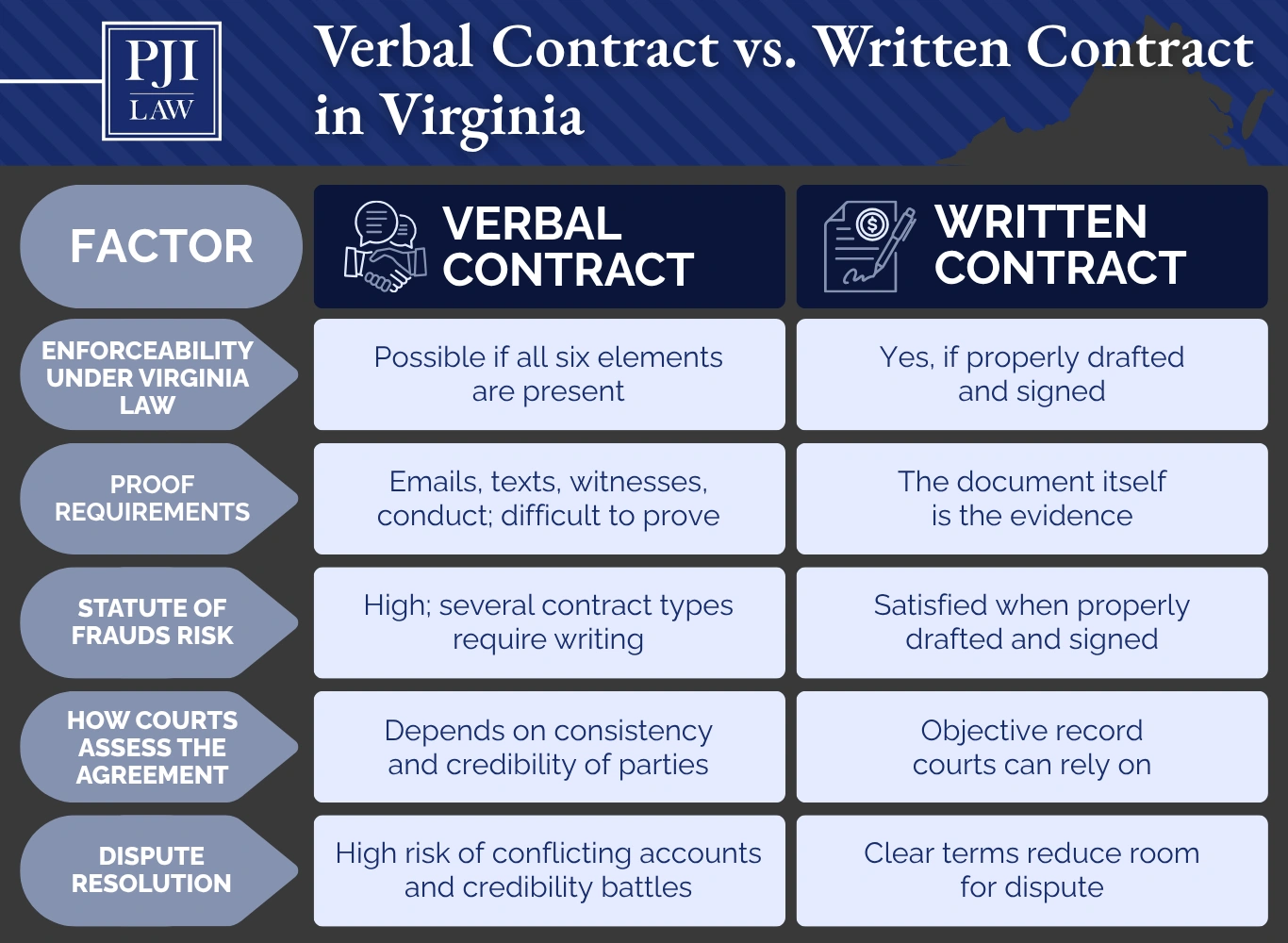
Here’s how verbal and written contracts compare under Virginia law:
A Practical Example of a Verbal Contract Dispute
You enter into a verbal agreement with another business for services. You complete the work, expecting payment based on what was discussed. The other party refuses to pay, claiming the agreement was different.
If you have supporting evidence such as emails, invoices, or proof of your own performance, you may be able to pursue a breach of contract claim. If you experienced a breach but have little documentation, the case becomes significantly harder to prove, and the other party’s version of events may carry more weight in court.
This is a common scenario in contract disputes, and it highlights why documentation matters even when a contract is legally valid. A contract lawyer reviewing your position early can help you assess what evidence you have and what legal strategy makes the most sense.
When You Should Put a Contract in Writing
While verbal agreements can be enforceable, relying on them creates unnecessary risk. You should strongly consider a written contract when:
- The agreement involves a large amount of money
- Performance extends over time
- Multiple parties are involved
- Your business interests or contractual obligations could be affected by a dispute
A written agreement provides clarity, reduces misunderstandings, and gives you stronger protection if a contract breach or contract dispute arises. It also gives both parties a shared reference point, which can prevent the kind of credibility battles that make oral contract claims so difficult.
Steps to Take If a Verbal Contract Is Broken
If you believe a contract breach has occurred, taking early action can help protect your position.
- Gather any communications or documentation that supports your claim, including messages, invoices, or proof of performance.
- Consider sending a demand letter to the other party, outlining what was agreed to and how the breach occurred.
- Speak with a contract attorney early to assess your legal rights, evaluate your options, and build a clear legal strategy.
Acting quickly matters. Evidence fades, witnesses forget details, and delay can weaken an otherwise strong breach of contract claim. Note that Virginia law under Va. Code § 8.01-246 generally provides five years to bring a claim on a written contract and three years on an oral contract, and the clock typically starts on the date of the breach, not the date of the agreement. The sooner you document what happened and seek legal representation, the better your position.

Frequently Asked Questions
Q: Do verbal contracts hold up in court in Virginia?
A: Yes, verbal agreements can be legally binding and legally enforceable under Virginia law if they meet the requirements of a valid contract and are not barred by the statute of frauds.
Q: What is the biggest issue with oral contracts?
A: Proof. Without written contracts, contract disputes often come down to conflicting accounts between the parties, and Virginia courts must weigh credibility rather than documentation.
Q: Can you sue for breach of a verbal agreement?
A: Yes. You can pursue a breach of contract claim if you can prove a valid contract existed, show what contractual obligations were agreed to, and demonstrate that the other party failed to perform.
Q: What types of contracts must be in writing?
A: Certain contracts, including real estate agreements, agreements that cannot be performed within a reasonable time, and promises to pay another’s debt, must be in a written agreement under the Virginia statute of frauds.
Q: What is anticipatory breach?
A: Anticipatory breach occurs when one party makes it clear, through words or actions, that they will not fulfill their obligations before their performance is actually due. In Virginia, this repudiation must be clear, absolute, and unequivocal. This allows the non-breaching party to pursue a legal claim immediately, rather than waiting for the actual date of performance to pass.
Q: Is a written contract always better?
A: From a documentation standpoint, yes. A written contract establishes clear contract terms, documents each party’s contractual obligations, and makes enforcement significantly easier if a dispute arises.
When a Verbal Agreement Is on the Line, Have a Legal Team in Your Corner
You shouldn’t have to argue over what was said. Whether you’re trying to enforce an oral agreement, defend against a breach of contract claim, or put stronger written contracts in place going forward, PJI Law, PLC is ready to help you take the right next step.
Our legal team works with clients across Northern Virginia on contract disputes of all kinds, from proving the terms of a verbal agreement in court to drafting written contracts that hold up when the pressure is on. We examine the facts of your situation, identify your legal options, and work alongside you at each stage of the process.
Our Virginia business contract attorneys know how courts weigh oral contracts, what evidence matters most, and how to build a legal strategy tailored to your specific circumstances.
Call (703) 865-6100 or contact us online to schedule your complimentary consultation today. From your first call to your final resolution, you’ll have a dedicated legal team standing behind you every step of the way.
At PJI Law, you’ll receive white-glove service and personal attention from a team that treats you like family.
Copyright © 2026. PJI Law, PLC. All rights reserved.
The information in this blog post (“post”) is provided for general informational purposes only and may not reflect the current law in your jurisdiction. No information in this post should be construed as legal advice from the individual author or the law firm, nor is it intended to be a substitute for legal counsel on any subject matter. No reader of this post should act or refrain from acting based on any information included in or accessible through this post without seeking the appropriate legal or other professional advice on the particular facts and circumstances at issue from a lawyer licensed in the recipient’s state, country, or other appropriate licensing jurisdiction.
PJI Law, PLC
3900 Jermantown Road, 2nd Floor
Fairfax, VA 22030
(703) 865-6100
https://pjilaw.com/
