


You want to do the right thing for your family. Maybe you’re thinking about transferring your primary residence to a child, helping a family member now instead of later, or trying to minimize taxes before your estate is passed on.
On the surface, gifting from an estate sounds simple. You give assets now, reduce your taxable estate, and avoid complications later. But what many people don’t realize is that the wrong decision can create serious tax consequences, affect Medicaid eligibility, or cost your family far more in the long run than they ever gain upfront.
Before you gift assets, it’s important to understand where things can go wrong and why those mistakes can have consequences years down the road.

At a Glance
- Gifting assets during your lifetime can reduce your taxable estate, but it can also eliminate valuable tax advantages tied to inherited property.
- The stepped-up basis available after a decedent’s death can significantly reduce capital gains tax compared to gifted property.
- Gifted property carries a carryover basis, which can increase taxable gain when sold.
- The annual gift tax exclusion allows limited tax-free transfers, but larger gifts may require a gift tax return.
- Adding a child to a deed as a joint owner can trigger the same tax and Medicaid issues as a direct gift, while also exposing the property to that child’s creditors.
- Gifting can impact Medicaid eligibility and trigger penalties under the 5-year look-back rule.
- Transferring assets too early may lead to loss of control and unintended financial consequences.
- A gift made without coordinating your broader estate plan can create accidental inequalities among beneficiaries or undercut your existing trust documents.
- Not all strategies that reduce estate taxes will benefit your family overall.

What Does Gifting From an Estate Actually Mean?
The phrase “gifting from an estate” can mean a few different things, depending on who’s using it. Some people use it to describe assets distributed after death through a will or a trust. Others are referring to lifetime gifting, transferring assets out of what you own now, while you’re still alive, to reduce the size of your taxable estate or support a family member sooner.
The risks discussed in this blog involve lifetime gifting, not assets distributed after death through a will or trust. That distinction carries weight because assets transferred during your life are treated very differently for tax purposes than inherited property received after death. What looks like a generous and practical decision today can drastically alter how capital gains tax is calculated later, leaving your loved ones with far less than you intended.
Why Gifting Assets Can Create Unexpected Problems
Gifting is often viewed as an easy way to simplify an estate, minimize taxes, and avoid probate. In reality, a single transfer ripples across multiple legal and financial areas.
You are not just transferring ownership. You are also changing:
- How cost basis is calculated
- How future capital gains are taxed
- Whether the asset qualifies for a stepped-up basis
- How your future Medicaid eligibility is evaluated
- Whether you retain any control over your own financial security
These consequences are rarely obvious when the gift is made. Recognizing where people commonly go wrong before you commit to a transfer can save your family thousands of dollars.
7 Mistakes to Avoid When Gifting From an Estate

1. Losing the Stepped-Up Basis and Triggering a Larger Capital Gains Tax Bill
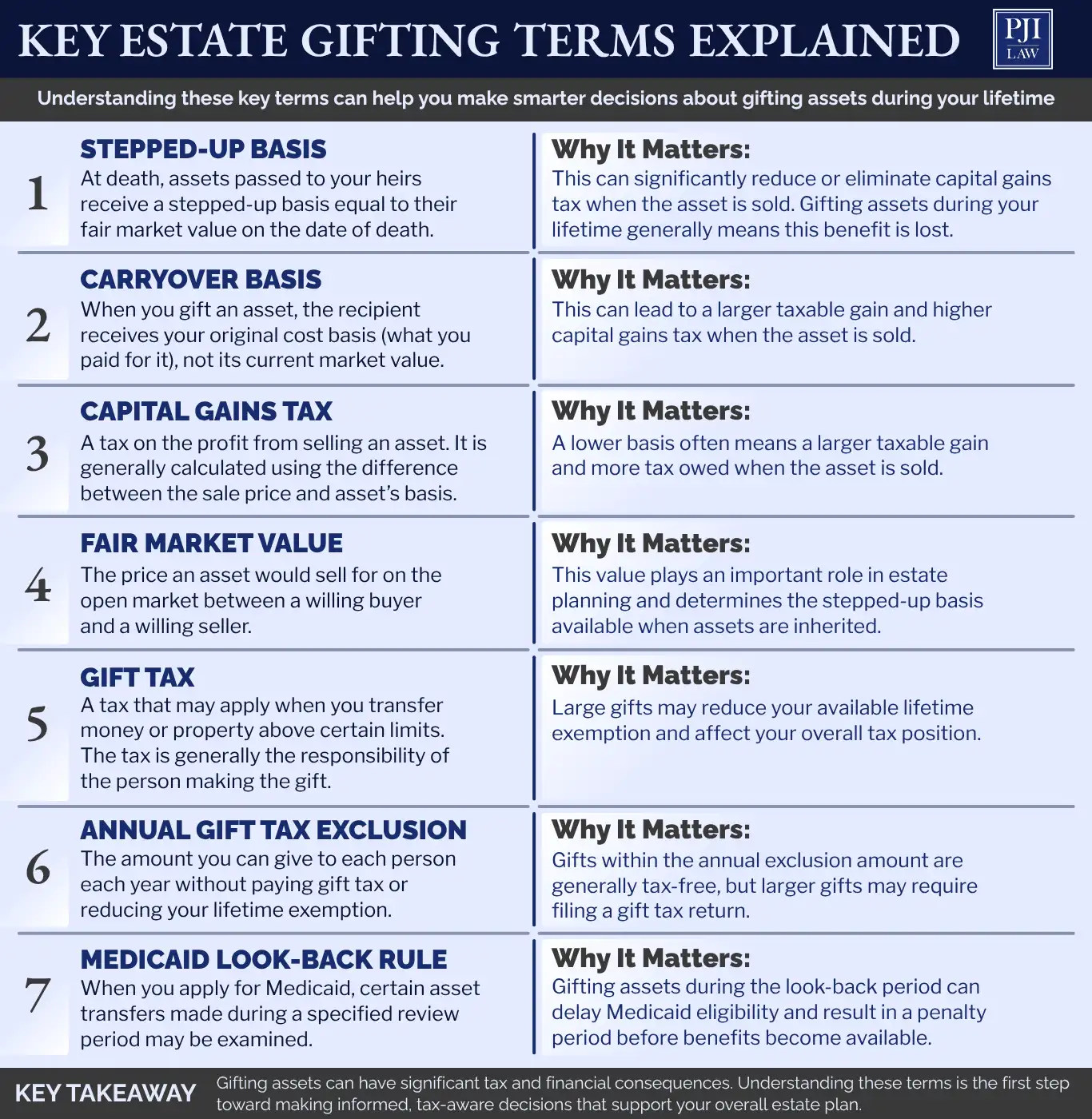
One of the costliest mistakes is giving away highly appreciated assets during your lifetime, and it usually comes down to one overlooked detail: cost basis. When property is inherited after your death, the beneficiary typically receives a stepped-up basis equal to the fair market value of the asset at the time of death.
This adjustment can wipe out decades of built-up capital gains tax exposure. When you gift that same asset while you’re alive instead, the recipient receives your original cost basis, known as a carryover basis, and that single difference can determine whether your family keeps more of the asset’s value or loses a portion of it to taxes. Understanding the difference between a stepped-up basis vs. carryover basis can fundamentally change your strategy.
For example, if you purchased a Richmond home decades ago for a low price and it has risen in value, gifting it now means your child inherits your original, low purchase price as their baseline. When they sell it, they will owe capital gains tax on gifted property based on the entire growth from the day you bought it, rather than the day they received it.
The tax bill doesn’t simply vanish because an asset was a gift; the liability transfers to your loved ones and can lead to an unnecessarily high bill when the asset is sold. This issue frequently complicates situations involving:
- A primary residence that has substantially appreciated over time
- Highly valued investment real estate or family land
- Stocks, mutual funds, or business interests held for the long term
2. Assuming Gifting Always Reduces Estate Taxes
While gifting shrinks the overall size of an estate, that doesn’t always translate into a net financial win for your family.
Virginia does not impose a state-level estate or inheritance tax, meaning residents only need to plan around the federal estate tax exemption. With the federal unified lifetime exemption sitting at a generous $15 million per individual (and $30 million for married couples), per the IRS’s 2026 estate and gift tax update, the vast majority of Virginia families will never owe a federal estate tax.
For individuals whose estates fall comfortably below that threshold, shrinking the estate yields no estate tax savings. Instead, it can strip your heirs of the massive capital gains tax savings provided by a stepped-up basis. The goal should always be minimizing your total tax exposure across all tax types.
3. Ignoring the Gift Tax Rules
The Internal Revenue Service (IRS) allows individuals to transfer a set amount of assets per recipient each year under the annual gift tax exclusion without filing paperwork. For 2026, this limit is $19,000 per recipient (or up to $38,000 for married couples utilizing gift splitting), as set out by the IRS.
However, failing to account for these rules can cause compliance headaches:
- Gifts exceeding the $19,000 limit per person require filing a Form 709 Gift Tax Return.
- Large lifetime transfers reduce your overall $15 million lifetime estate tax exemption.
- Failing to file required returns can lead to IRS audits and compliance penalties down the road.
Filing a gift tax return doesn’t necessarily mean you will owe tax out-of-pocket today, but it is a strict legal tracking requirement that must be managed before making large transfers.
4. Adding a Child to the Deed Instead of Planning the Transfer Properly
Many parents add an adult child’s name to the deed of their home as a joint owner, thinking it’s a quick, no-cost way to skip probate. In practice, this move can create as many problems as it solves.
It’s treated as a present gift of a partial interest in the home, which means the portion given away carries the same carryover basis issue described in Mistake 1. It exposes the home to the child’s creditors, a divorce settlement, or bankruptcy proceedings, since the child now holds a legal ownership interest the parent can’t unilaterally undo.
It can complicate Medicaid planning, since adding a joint owner is itself a transfer that may need to be disclosed and reviewed under the look-back rule. It doesn’t always avoid probate the way people expect, particularly if the child predeceases the parent or other children are left off the deed, which can create friction among siblings later.
A deed change is not a substitute for a coordinated estate plan. Whatever the underlying goal, probate avoidance, tax planning, or providing for a specific child, it’s worth discussing with an attorney before retitling property.
5. Overlooking Medicaid Eligibility and the Look-Back Rule
Gifting can directly affect Medicaid eligibility, particularly for those planning for long-term care. An important rule to understand is the 5-year (60-month) Medicaid look-back period in Virginia, set out in 12VAC30-40-300, which allows state agencies to review certain asset transfers made before an individual applies for benefits. If assets are transferred below fair market value during that time:
- A penalty period will be imposed.
- Eligibility for benefits will be delayed, often by months or years.
- Access to essential medical assistance services could be cut off, leaving your family to pay out-of-pocket.
Medicaid also considers strict asset limits, countable assets, and spend-down requirements. For married couples, coordinating asset transfers while protecting a community spouse (the spouse remaining at home) requires highly technical legal structuring. A casual gift to a child today can jeopardize your medical care tomorrow.
6. Giving Up Control Too Soon
Once you legally transfer ownership of an asset, your authority over it terminates. This loss of control can directly threaten your lifestyle and independence, impacting:
- Your legal right to live in or manage your primary home
- Your access to emergency funds if your personal financial health changes
- Your ability to stop the asset from being seized by a child’s creditors, an ex-spouse in a divorce, or bankruptcy proceedings
For example, gifting a home to a family member may seem like a straightforward decision. However, you cannot legally force them to let you stay there, nor can you reverse the transfer if your relationship changes. In many cases, utilizing an irrevocable trust or other sophisticated planning vehicles allows you to achieve tax or protection goals without entirely abandoning financial security.
7. Failing to Coordinate With Your Broader Estate Plan
An isolated gifting decision can easily trigger an accidental domino effect across your entire estate strategy. Without proper coordination, an unmonitored lifetime gift can:
- Create accidental inequalities among your children or beneficiaries
- Short-circuit protective instructions established inside your existing trust documents
- Disproportionately reduce a surviving spouse’s intended share of assets
- Interfere with Medicaid planning or spend-down strategies
Each asset transfer should function as a coordinated piece of your broader plan, rather than a quick fix for an isolated objective.

An Example of How Gifting Can Backfire
Consider this scenario. A parent adds her adult son to the deed of her home as a joint owner, intending to avoid probate. Two years later, she needs nursing home care and applies for Medicaid. Because the deed change counts as a gift of half the home’s value, and it happened within the 60-month look-back period under 12VAC30-40-300, the transfer has to be disclosed and factored into a penalty period.
If the home is worth $500,000, she gave away an interest worth $250,000. Using a hypothetical average monthly private-pay nursing facility rate of $9,000 for illustration (the actual rate is set annually by DMAS and should be confirmed as of the application date), dividing $250,000 by $9,000 produces a penalty period of just under 28 months during which Medicaid will not pay for her care.
The deed change meant to simplify things instead delays her access to benefits at the exact point she needs them, leaving her family to cover the cost of care out-of-pocket until the penalty period ends. This example uses assumed values; the actual penalty period in any specific case depends on the property’s value, the number of joint owners, and the DMAS rate in effect at the time of application.
When Gifting Assets May Make Sense

Despite the inherent risks, a proactive gifting strategy can be incredibly effective under the right conditions. It may be appropriate if:
- Your total net worth puts you at risk of exceeding federal estate tax thresholds.
- You want to move rapidly appreciating assets out of your name so future growth occurs within your children’s estates.
- You want to provide immediate, targeted financial support to a family member or cover tuition costs.
- You are making strategic charitable contributions to lower your annual income tax brackets.
- You are working with an estate planning attorney to structure the transfer safely.
The defining factor is whether the transfer is structured carefully alongside an estate professional who evaluates the total tax impact first.
When It May Be Better to Wait
For many Virginia families, holding onto assets and transferring them through a clear, legally sound inheritance structure produces a safer, more favorable tax position for their heirs. Waiting preserves your options, locks in a stepped-up basis for your heirs, protects your Medicaid eligibility window, and lets you maintain full operational control over your life savings.
Factors that influence this decision include the specific type of asset, its current market value, its future appreciation potential, and your long-term medical care needs.
When to Speak With an Estate Planning Attorney
Gifting decisions touch on federal tax codes, Virginia property laws, and state Medicaid rules all at once. Before signing over a deed or writing a substantial check, consult a legal and financial professional to evaluate:
- How the transfer affects cost basis and capital gains taxes
- Whether it impacts Medicaid eligibility requirements and look-back periods
- Whether alternative strategies (like trusts) could work better for your situation
- How the decision fits into your comprehensive estate plan
At PJI Law, PLC, our Richmond, VA estate planning attorneys work with families to evaluate gifting strategies, minimize exposure to capital gains tax, and draft comprehensive estate plans that align with your goals while taking care of your family.

Frequently Asked Questions
Is gifting better than inheritance?
It depends. Inherited property often receives a stepped-up basis, which can reduce capital gains tax, while gifted property may lead to a larger taxable gain.
Do I have to pay capital gains tax on gifted property?
A person may need to pay capital gains tax when the property is sold, based on the original cost basis rather than the fair market value at the time of transfer.
What is the annual gift tax exclusion?
The annual gift tax exclusion allows you to transfer a certain amount each year ($19,000 per recipient) without filing a gift tax return or reducing your lifetime exemption.
Does the recipient pay gift tax?
Typically, the person making the gift is responsible for any gift tax, not the recipient.
Will gifting assets affect Medicaid eligibility?
Transfers made within the 5-year look-back period can affect Medicaid eligibility and may lead to penalties.
What is a stepped-up basis?
A stepped-up basis adjusts the value of inherited assets to their fair market value at the time of death, which can reduce taxable gain.
What is a carryover basis?
A carryover basis means the recipient receives the donor’s original cost basis, which may increase capital gains when the asset is sold.
Can I gift my primary residence to a family member?
A primary residence can be gifted to a family member, but doing so may create tax implications, affect control, and impact Medicaid planning.
Do I need to file a gift tax return?
A gift tax return may need to be filed if the gift exceeds the annual gift tax exclusion limit.
Should I talk to a tax professional before gifting assets?
A tax professional or financial advisor can explain the tax implications so you can avoid costly mistakes.
Make Gifting Decisions With Your Complete Estate Plan in Mind
Deciding when and how to gift assets is not just about reducing your estate. It’s about protecting your financial future and your family’s long-term interests. Avoiding these common mistakes can help you make more informed decisions about when and how to transfer assets as part of your overall estate plan.
At PJI Law, PLC, our Richmond, VA estate planning attorneys sit down with you to map out your assets, your family’s needs, and the tax rules that apply to your specific situation, then build a plan around those details rather than guesswork.
Call (804) 653-3450 to schedule a complimentary consultation. You can also complete our confidential online form if that is more convenient.
At PJI Law, you’ll receive white-glove service and personal attention from a team that treats you like family.
Copyright © 2026. PJI Law, PLC. All rights reserved.
The information in this blog post (“post”) is provided for general informational purposes only and may not reflect the current law in your jurisdiction. No information in this post should be construed as legal advice from the individual author or the law firm, nor is it intended to be a substitute for legal counsel on any subject matter. No reader of this post should act or refrain from acting based on any information included in or accessible through this post without seeking the appropriate legal or other professional advice on the particular facts and circumstances at issue from a lawyer licensed in the recipient’s state, country, or other appropriate licensing jurisdiction.
PJI Law, PLC
4108 E Parham Road
Richmond, VA 23228
(804) 653-3450
https://pjilaw.com/
