


Most families spend months getting ready for college move-in day. You research the school, coordinate housing, handle tuition payments, and make sure your child has everything they need. What most Richmond families don’t think about until it’s too late is the legal gap that opens the moment your child turns 18.
If you’re wondering why a power of attorney for a college student matters, the answer is this: Once your child becomes a legal adult, you lose the authority to act on their behalf. That loss is immediate under Virginia law, regardless of whether you’re paying tuition, you’re carrying them on your insurance, or they’re listed as an emergency contact.
If your child is already in college and these documents aren’t in place, it’s not too late. Any college student over 18 can execute these documents at any time, and there’s no reason to wait until the next move-in day to get them in order.

At a Glance
- What this is: Legal documents that authorize you to act for your child after they turn 18
- Why it matters: Without them, you may be legally unable to make medical or financial decisions in a crisis
- What you need: A Financial Power of Attorney, an Advance Medical Directive, and a HIPAA Authorization
- Who is involved: Your child as the principal (the one granting authority) and you as the authorized representative
- When to act: Before move-in day in Richmond, Virginia
What Changes the Moment Your Child Turns 18
Under Virginia law, your child becomes a legal adult at 18. That single change has real consequences, and most families don’t discover them until they’re facing a medical crisis or financial emergency.
Before your child turned 18, you had the legal authority to access their medical records, speak with their doctors, manage their finances, and make decisions on their behalf. After they turn 18, that authority is gone. It doesn’t matter that you’re their parent. Hospitals, banks, and universities are bound by federal and state privacy laws that treat your child as an independent adult.
Specifically, you may find yourself unable to:
- Access your child’s medical records under federal privacy law
- Speak with doctors or healthcare providers about their condition
- Make health care decisions if your child is unconscious or incapacitated
- Access or manage their bank account
- Handle financial transactions on their behalf
- View grades, financial aid details, or disciplinary records, which are protected under FERPA, the federal privacy law that governs academic records at colleges and universities
Most parents are surprised to learn that paying tuition doesn’t give them any automatic right to see their child’s grades or speak with the financial aid office. Once your child turns 18, those records belong to them under federal law, regardless of who is footing the bill.
This isn’t a theoretical concern. Families across Richmond face these barriers each year when something unexpected occurs. The legal system isn’t designed to make exceptions for well-meaning parents without the proper paperwork in place.

Why This Matters More Than Most Families Realize

Consider what happens if your child is injured in an accident and taken to a Richmond hospital. You receive a call and drive to the emergency room. When you arrive, you ask about their condition. The hospital can’t tell you. You ask to speak with the treating physician. You’re told they can’t discuss the case without authorization.
You try to give direction on treatment. You’re informed you don’t have legal authority to do so. This isn’t the hospital being difficult. It’s the hospital following the law.
Without a properly executed medical directive and federal privacy authorization, you’re legally a stranger to your child’s healthcare team. The only way to gain authority at that point may be through a court guardianship proceeding, which takes time, costs money, and creates delays at the worst possible moment.
Families are surprised to learn how quickly this situation develops. The good news is that it’s entirely preventable. Three legal instruments, prepared before move-in day, give you the authority you need to act when it counts. Getting these authorizations in place is one of the easiest things you can do to protect your child before they leave home.
Three Vital Legal Documents Each College Student Needs Before Move-In Day
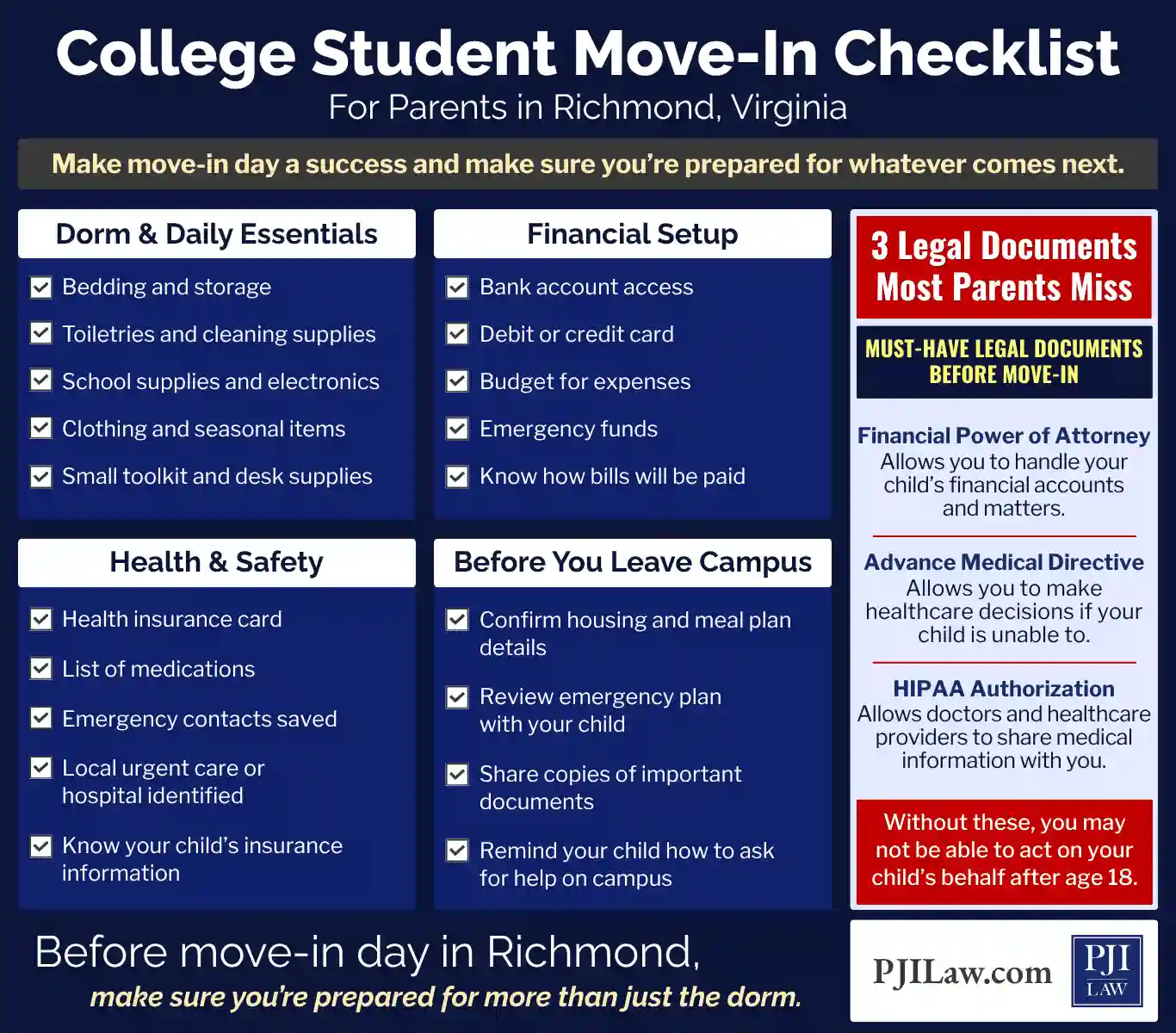
Many families make the mistake of thinking one document is enough. It isn’t. Each covers a different area of your child’s life, and all three need to be in place before move-in day.
1. Financial Power of Attorney
A financial power of attorney allows your child to appoint you as their authorized representative to handle financial matters. Under Virginia’s Uniform Power of Attorney Act (Va. Code § 64.2-1600 et seq.), this paperwork can cover a broad range of financial decisions or be limited to specific transactions.
As the named representative under a financial power of attorney, you may be authorized to:
- Access and manage their bank account and other funds.
- Pay tuition, housing costs, and other college expenses.
- Handle unexpected financial transactions.
- Manage assets held in their name.
- File tax returns on their behalf if needed.
- Communicate with the university registrar, financial aid office, and billing department on your child’s behalf, although schools may still require separate FERPA authorization for access to certain academic records.
- Sign housing contracts, enrollment forms, or other university paperwork remotely if your child is unable to do so.
In practical terms, this means you can step in to handle the kinds of administrative tasks that come up during a college career, from resolving a billing dispute to signing a housing renewal when your child is studying abroad or dealing with a health issue. A power of attorney gives you the legal standing to make those requests. Whether a specific university portal or digital system grants you direct access will depend on that institution’s own policies, but having the paperwork in place puts you in a far stronger position to work with the school.
A durable power of attorney is particularly important for college students because it remains in effect even if your child becomes incapacitated. Without the durable designation, a standard power of attorney terminates the moment your child loses capacity, which is exactly when you need it most.
2. Advance Medical Directive
Virginia law allows your child to execute an advance medical directive that names you as their healthcare representative and outlines their wishes for medical treatment. Under Va. Code § 54.1-2983, this paperwork gives you the legal authority to communicate with healthcare providers and make health care decisions if your child is unable to do so.
As your child’s healthcare representative, you may be authorized to:
- Speak directly with doctors and specialists.
- Access medical records and test results.
- Approve or decline recommended treatments.
- Make decisions during a medical emergency when your child can’t communicate.
- Coordinate care across multiple providers.
Without this paperwork, healthcare providers are legally prohibited from sharing information or accepting your direction, even in a life-threatening situation. Virginia hospitals follow these rules strictly, and Richmond area medical centers are no exception.
3. HIPAA Authorization
The Health Insurance Portability and Accountability Act (HIPAA) restricts who can access a patient’s medical information. Even with an advance medical directive in place, a separate HIPAA authorization form is recommended to give providers clear written permission to communicate with you.
A HIPAA authorization allows providers to:
- Release medical records directly to you.
- Discuss your child’s diagnosis, treatment, and progress.
- Respond to your questions and requests for information.
- Coordinate with your child’s insurance company on their behalf.
Without a HIPAA authorization, providers may decline to share even basic information about your child’s condition, including whether they’re being treated at all. This paperwork works alongside the advance medical directive rather than replacing it.
What These Documents Actually Give You
Together, these three documents give you something no emergency contact designation or parental instinct can provide: legal authority. When something happens, you won’t be waiting for someone to make an exception. You’ll have paperwork that clearly establishes your right to act.
With all three documents properly executed under Virginia law, you may be able to:
- Make time-sensitive medical decisions without court involvement
- Access and share medical records with specialists or insurance providers
- Manage your child’s finances while they recover
- Pay bills, handle accounts, and protect against financial disruption
- Communicate directly with your child’s healthcare team
- Act on your child’s behalf across a wide range of situations
The peace of mind that comes with having these legal documents in place is real. You’re not hoping someone will work with you. You have the legal standing to step in.
What Happens Without These Documents

If your child turns 18 and leaves for college without these authorizations, you’re operating without a safety net. Most of the time, nothing will go wrong, and you’ll never need them. But if something does happen, the barriers you’ll face are significant.
Without proper authorization, you may encounter:
- Hospitals that can’t legally discuss your child’s condition or share records
- Financial institutions that won’t grant you access to accounts
- Doctors who can’t accept your direction on treatment decisions
- University administrators who can’t discuss your child’s academic or financial standing
- Court proceedings to establish guardianship or conservatorship, which can take weeks and cost thousands of dollars
The guardianship process in Virginia requires filing a petition with the circuit court, obtaining a guardian ad litem for your child, scheduling a hearing, and waiting for a judge’s order. During that time, critical decisions may be delayed. It’s a process designed for situations where no planning was done in advance, and it’s far more burdensome than preparing the right paperwork before move-in day.

Choosing the Right Representative
Your child gets to decide who serves as their representative. Most college students name one or both parents. Some also name a backup in case the primary representative is unavailable.
When your child is deciding who to name, consider:
- Availability. Can this person drop everything and respond quickly if something happens?
- Location. Are they close enough to Richmond to act in person if needed? If both parents travel frequently or live far from Richmond, consider naming a trusted local family member or close friend as a backup representative who can respond in person quickly if needed.
- Judgment. Will they make decisions that reflect your child’s values and wishes?
- Communication. Can they work with medical providers, financial institutions, and other parties under pressure?
It’s worth having an honest conversation with your child about who they trust to act on their behalf and under what circumstances. These documents reflect your child’s choices, and they should feel comfortable with whoever is named.
Virginia Legal Requirements
Virginia has specific requirements for these documents to be legally valid. Working with a Richmond, VA estate planning attorney helps make sure each one is properly executed and enforceable.
For a financial power of attorney to be valid under Virginia law, it must generally be signed by your child and acknowledged before a notary public. The Virginia Uniform Power of Attorney Act governs financial powers of attorney and sets out your rights and limitations as the named representative.
For an advance medical directive to be valid under Va. Code § 54.1-2983, your child must sign it in the presence of two witnesses, who must also sign the directive. The witnesses can’t be the person named as healthcare representative, a relative, an heir, or anyone who would benefit financially from your child’s death.
Virginia also maintains an Advance Health Care Directive Registry where your child can file the document after signing it. Filing with the registry makes the directive accessible to healthcare providers across the state, which is particularly valuable if something happens while your child is away from home and their providers in Richmond don’t have a copy on file.
Generic online templates may not meet these requirements. A document that doesn’t comply with Virginia law may be rejected by a hospital, bank, or other institution at exactly the moment you need it accepted.
Common Mistakes to Avoid
Even parents who know these documents exist often make mistakes in how they handle them.
- Completing only one document. Each covers a distinct area. A financial power of attorney doesn’t give you access to medical records. A HIPAA authorization doesn’t authorize you to manage your child’s bank account. And even if you have both, without an advance medical directive naming you as healthcare representative, you may not have clear legal authority to make or enforce medical decisions on your child’s behalf if they are unconscious in a Richmond emergency room. All three serve different purposes and all three are needed.
- Waiting until something happens. Once your child is incapacitated or in a medical crisis, it’s too late to execute these documents. Your child must have legal capacity to sign, which means the paperwork must be prepared while everything is fine.
- Using generic templates. Virginia has specific execution requirements. A document that doesn’t meet those requirements may be unenforceable.
- Not keeping paperwork accessible. These documents are only useful if you can produce them when needed. Keep originals in a secure but accessible location, provide copies to your child’s healthcare providers if appropriate, and make sure your child knows where everything is stored.
- Forgetting to update them. Your child’s circumstances will change over the years of college and beyond. If they move to a different state after graduation, enter a serious relationship, or their financial situation changes significantly, the documents should be reviewed and updated accordingly.
How This Fits Into a Broader Virginia Estate Planning Strategy
Most parents don’t think of a college student’s power of attorney as part of estate planning. But under Virginia law, these documents are part of the same framework that governs wills, trusts, and advance directives for adults of any age.
For Richmond families, creating these documents before move-in day is often the first step in helping your child build their own estate plan. It introduces them to concepts like granting legal authority, naming trusted representatives, and putting their own wishes in writing. It also gives you the opportunity to coordinate your child’s paperwork with your own estate plan, making sure wills, trusts, beneficiary designations, and powers of attorney work together as a unified whole.
Richmond, Virginia estate planning attorneys who work with families on college preparation can also help you review your own documents at the same time. If your own powers of attorney or advance directives haven’t been updated recently, your child’s move-in day is a natural moment to address that, as well.

Frequently Asked Questions
Q: Do I need an attorney to create these documents in Virginia?
A: You’re not legally required to use an attorney, but Virginia’s execution requirements are specific, and a document that doesn’t meet them may be rejected when you need it most. Working with a Richmond estate planning attorney helps make sure each document is properly drafted, witnessed, notarized, and enforceable under state law.
Q: Can I access my child’s bank account without a power of attorney?
A: No. Financial institutions require written legal authorization. Without a valid financial power of attorney, you won’t be granted access to your child’s account regardless of your relationship to them.
Q: What happens if my child becomes incapacitated and has no documents in place?
A: You’d need to petition the Virginia circuit court for guardianship and conservatorship. That process involves legal filings, court hearings, and a waiting period during which you may be unable to act. It’s significantly more time-consuming and costly than preparing paperwork in advance.
Q: Can my child revoke these documents?
A: Yes. Your child remains in full control and can revoke or update the paperwork at any time as long as they have legal capacity to do so. Executing these documents doesn’t limit your child’s independence in any way during their day-to-day life.
Q: Do these documents expire?
A: They don’t expire automatically, but they should be reviewed periodically. If your child attends college out of state or moves to another state after graduation, it’s worth confirming that the Virginia documents will be recognized there. Virginia documents are often accepted in other states when properly drafted, but an attorney can build in language that strengthens out-of-state recognition and gives your child’s documents a much broader reach.
Protect Your Child Before Move-In Day
Between housing assignments, orientation schedules, and everything else on your list, college move-in day arrives faster than most families expect. Legal paperwork is one of the easiest things to overlook, and one of the hardest to fix once something goes wrong. Whether your child is heading to campus for the first time or is already enrolled, the time to act is now.
At PJI Law, PLC, our Richmond, VA estate planning attorneys have years of experience working with clients and families to protect their loved ones with powers of attorney, medical directives, and HIPAA authorizations for college students heading into their next chapter. We take the time to understand your family’s situation, answer your questions, and prepare paperwork that’ll hold up when it’s needed most.
Our clients consistently tell us that getting these documents in place before move-in day gave them real peace of mind throughout their child’s college years. We have the experience to handle that process efficiently for your family, as well.
Call (804) 653-3450 to schedule a complimentary consultation before move-in day. You can also complete our confidential online form on our website if that’s more convenient.
At PJI Law, you’ll receive white-glove service and personal attention from a team that treats you like family.
Copyright © 2026. PJI Law, PLC. All rights reserved.
The information in this blog post (“post”) is provided for general informational purposes only and may not reflect the current law in your jurisdiction. No information in this post should be construed as legal advice from the individual author or the law firm, nor is it intended to be a substitute for legal counsel on any subject matter. No reader of this post should act or refrain from acting based on any information included in or accessible through this post without seeking the appropriate legal or other professional advice on the particular facts and circumstances at issue from a lawyer licensed in the recipient’s state, country, or other appropriate licensing jurisdiction.
PJI Law, PLC
4108 E Parham Rd,
Richmond, VA 23228
(804) 653-3450
https://www.pjilaw.com/
